
Year 12 English Literature OCR A-Level Coursework : 94% Final Grade
In both Beowulf and Antigone, heroism is inseparable from the strength and integrity of one’s relationships, measured through bonds with kin, ancestry, and the divine. In Heaney’s Beowulf, heroism reflects the Germanic heroic code: skill in battle, loyalty to one’s lord, and protection of kin secure social cohesion and ancestral honour, while failure to maintain these obligations compromises heroic identity. Figures like Grendel and his mother complicate this notion: each demonstrates formidable power, with the mother avenging her son, but their exclusion from human and divine networks prevents them from achieving enduring heroic status. Their courage is undeniable, yet without allegiance to kin or community, their actions remain incomplete. In Antigone, heroism follows the Greek tragic standard, indivisible from relational conflicts and Aristotelian principles. As Segal observes, “Antigone is the balance in which Creon is weighed, and found wanting; on the other [hand], Antigone’s harshness would make no sense without Creon’s authoritarian wilfulness… the two coexist as complementary parts of a whole”[1]. Her heroic position is only fully realised in conjunction with Creon, whose obstinacy defines the stakes against which her resolve and moral clarity are measured. Antigone cannot emerge as a tragic hero in isolation – her heroism is constituted through the tension created by Creon’s actions and his subsequent regret. Across both texts, heroism is never achieved alone; it is sustained through characters’ interactions, showing that kinship and loyalty are central to the heroic ideal.
Heroism, in both texts, arises most obviously in obligations to one’s closest kin, whose responsibilities endure even beyond death, revealing that heroism is grounded in the maintenance of close familial bonds. In Beowulf, Hrothgar’s account of repairing Ecgtheow’s feud – “I shipped a treasure-trove to the Wulfings and Ecgtheow acknowledged me with oaths of allegiance”[2] – clarifies the origin of Beowulf’s personal intervention, which stems from the inherited obligation initially found in his father’s relationships. Beowulf’s journey to aid Hrothgar honours the debt owed by his own father thus demonstrates how heroic action perpetuates these first bonds, thereby reinforcing the broader network of kinship to which he belongs.
Hrothgar’s later acknowledgement, “So now, Beowulf,/ I adopt you in my heart as a dear son./ Nourish and maintain this new connection,/ you noblest of men”[3], further reveals heroism as the capacity to extend bonds beyond their original scope. It also functions as a performative speech act, ratifying the newly bestowed kinship, and enlarging Beowulf’s heroic stature because his victories have upheld this foundational bond. His bravery becomes heroic insofar as it crosses borders, linking Danes and Geats through obligations that originate in his immediate kinship to his father.
Beowulf’s heroism extends to the closest living kin in his society, as seen in the swustersenu bond with Hygelac: “The warrior king/ was uncle to Beowulf and honoured by his nephew”[4]. The swustersenu tie was regarded as the closest kin-bond in Germanic culture because the nephew’s mother and the uncle share the same parents, giving them an undivided common lineage. Glosecki stresses that “in this kind of kinship system… the bond between maternal uncle and uterine nephew eclipses the bond between father and son. It is the most important bond of all, economically and politically”[5], placing the hero under maximal expectations of loyalty toward this immediate kin-group. Beowulf reflects this priority: “be sure also, my beloved Hrothgar,/ to send Hygelac the treasures I received,”[6] reaffirming that heroic success is measured by how fully one returns wealth and honour to one’s closest family. Ball similarly contends “[that] the hero can only successfully function as a part of a collective. In a society of quid pro quo loyalty, more is gained from being a part of the collective than from remaining an unassociated individual”[7], and that “the successful hero of Anglo-Saxon society was the collective hero, and to be a hero of the collective he must wholly and primarily be a part of the collective”[8]. Beowulf thus exemplifies a heroic distinction in which glory manifests through loyalty within the comitatus, fulfilling obligations to his father and extended to Hrothgar and Hygelac.
In Antigone, heroism is likewise rooted in family obligation, expressed instead through allegiance to deceased kin even when this conflicts with civic law. Wolman emphasises that belonging to a community is essential: “the soul was exposed to an eternal curse of being and not-being, of a never-ending exile from life without entry into the peaceful kingdom of shadows”[9] (2), revealing how heroism extends to protecting and memorialising the dead. In Beowulf he honours his dead kin by sustaining the relationships his father forged; in Antigone she intransigently honours the dead through direct burial and remembrance, thus elevating her to a heroic position in caring for those who can no longer defend themselves. She explains, “this honourable deed is mine,”[10] employing declarative authority to assert ownership over her action, exemplifying that her duty to Polynices precedes civic law and that her heroism is inseparable from the defence of immediate kin. Wolman reinforces this courage: “heroes were men who willingly suffer for others and accept pain and anguish to pave a better future for others”[11], capturing the self-sacrifice that validates Antigone’s heroism as she secures Polynices’ afterlife.
Creon also attempts to claim legitimacy through familial connection – “It is I that hold the power and throne by reason of my kinship with the dead…”[12] – yet voids this assertion by condemning Polynices’ body “to be left at the side of the road for birds and dogs to fight over his bones”[13]. There is an irony here as he verbally asserts kinship while actively denying it. His prioritisation of the polis – framed as “a law to protect the citizens”[14] – leads him to imprison Antigone and sentence her to death, demonstrating his belief that civic duty supersedes family. As Chou observes of McCafferty’s Belfast Production, “no real reconciliation or lasting peace comes to a city that forgets and dishonours its own, even those whose hands are stained with the blood of their kin,”[15] emphasising the fatality of such a mistake. In ancient Greek society, oikos was considered priority, and loyalty to one’s blood was inseparable from one’s honour. Chamberlain explains the notion of burial duty as familial imperative: “Families bore the greatest responsibility for burial of the deceased, a duty which was carried out… with fierce pride”[16]. By condemning Antigone for carrying this honour out, he indirectly causes the deaths of Haemon and Eurydice too, who cannot survive the collapse of their closest family ties. Creon’s prioritisation of municipal authority blinds him to the relational obligations that define heroism, ultimately resulting in the demise of his immediate kin.
In both texts, heroism originates within the intimate sphere of kinship: Beowulf’s loyalty strengthens social cohesion, demonstrating heroism through enduring fidelity to his immediate kin, whereas Antigone achieves heroic renown by defending her brother even at the cost of her own life. In each case, heroic identity manifests in actions that protect and preserve immediate kin before extending into wider ancestral or divine realms.
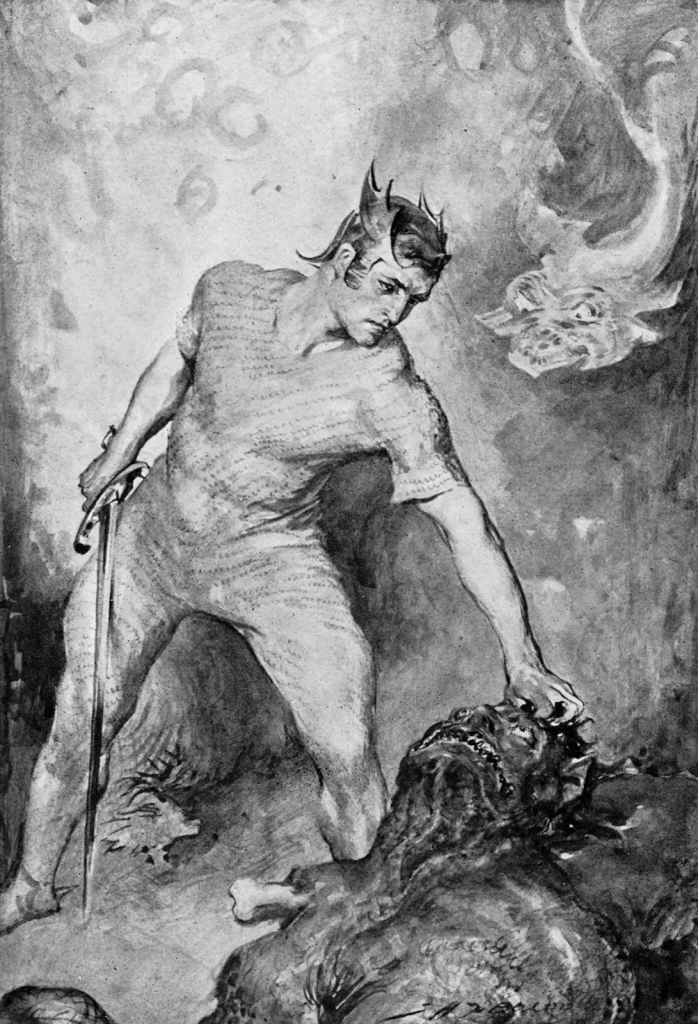
Both Beowulf and Antigone extend heroism beyond earthly kinship by locating it in a character’s relationship with divine authority. In Beowulf, the poet’s Christian diction frames victory as a divine gift: “a man,/ with the Lord’s assistance, has accomplished something/ none of us could have managed before now”[17]; “holy God/ decided the victory”[18]. Ball explains this dynamic: “all glory is to be given to God instead of man- a divine Lord versus a human lord”[19], suggesting that the Beowulf-poet projects the earthly lord-retainer bond into a parallel relationship with a divine king (God). This theological framing imposes the poet’s Christian structure on a pagan narrative so that divine favour becomes the prerequisite for heroic recognition. Kroll counters that the poem gives “primary value to men’s responsibility to and dependence on other men, rather than to their relationship to God”[20]. Kroll is right to stress that Beowulf’s heroism is tested through human reciprocity; but the text itself, influenced by Heaney, presents divine relationships as the precursor to human collaboration- its absence producing estrangement in characters like Grendel and his mother. In practice, the hero who secures the comitatus does so within a narrative that has already sanctioned his actions by means of “the one true God who rules at all times over all”[21].
This affects how we read the monsters. Grendel is described in theological terms- “a fiend out of hell”[22], “God-cursed brute”[23], “malignant by nature”[24], and then physically and socially placed beyond reach: “he was kept from approaching; he was the Lord’s outcast”[25]. The apposition emphasises his inherited damnation, highlighting how “exile from human civilisation is hell”[26], and the caesura respects Old English verse lineation, showing a clear cause-and-effect: divine rejection produces his exclusion from the human world. Kroll’s point, that heroism consists in acting rightly toward men, therefore explains why Grendel cannot be heroic: his severed bond with God removes him from the community of men altogether, leaving him unable to participate in the social obligations that constitute heroic kinship. Therefore, Kroll’s observation that “the monster has a measure of the hero’s capacity for affiliation but is never a keeper of civilisation”[27] shows how the monsters may imitate human behaviour, but without divine or human kinship they cannot sustain the relationships that define heroic responsibility.
In Antigone, heroism similarly depends on maintaining the correct relationship with the gods. Segal observes that “the realm of the gods… defines the boundaries of what man can know”[28], revealing that true understanding of heroic action derives from divine authority. Antigone submits to these rules: she is insistent in her rejection of Creon’s authority “because it comes from [him] and not from Zeus”[29], reaffirming that divine law overrides human command. Creon, by contrast, compromises his divine relationship: his claim that “Zeus is still respected through my authority”[30] attempts to prioritise his own law over sacred command, ironically subordinating divine authority to his personal will. Segal notes that Creon “understands nothing of the limits on human power… for him, to know the ways of men is also to know the ways of the gods”[31]; his hubris blinds him to this knowledge, and by rejecting divine relationship he forfeits heroic claim. Whereas the Beowulf-poet presents divine favour as necessary to enable human bonds and attain heroic recognition, Antigone demonstrates that heroic identity in Greek terms is inseparable from direct allegiance to the gods.
In both Beowulf and Antigone, heroic identity is influenced by inherited legacy- the deeds, status, and failings of ancestors set the conditions under which one can achieve renown. In Heaney’s Beowulf, lineage serves as the first test of heroic potential. Wulfgar interrogates Beowulf, demanding “I have to be informed/ about who you are and where you hail from”[32], and establishing that heroic validation depends on reputation. Beowulf’s response, “My father was a famous man”[33], situates him in an eminent heritage. As Ball notes, “Beowulf’s entrance into Heorot and the audience of Hrothgar hinges on the hero’s lineage”[34], later stressesing that Beowulf’s identity “was not solely individual, but part of a nationality and family line”[35]. Here, Beowulf’s pride in his father’s reputation demonstrates that his heroism is inseparable from inherited filial obligations; he acts as an extension of his family’s reputation. Moreover, the poem opens with Shield Sheafson, the archetypal ancestor-hero whose achievements establish the standard Beowulf must emulate, emphasising that heroism is conditioned by those who came before. Conversely, Grendel and his mother illustrate how ancestry can forbid heroic status. Grendel’s mother dwells “[in] the heaving/ depths of a lake [where] it was the better part of a day/ before he could see the solid bottom”[36], a setting that literalises her social exclusion. Yet she enacts the same revenge ethic that defines the heroic code: an eye-for-an-eye, avenging her beloved son’s death by targeting Aeschere (“To Hrothgar, this man was the most beloved”[37]). Her actions mirror the culturally-sanctioned obligations of the Germanic heroic world, but her descent from Cain renders her deeds unheroic. Beowulf highlights this tension when remarking, “It is always better/ to avenge dear ones than to indulge in the morning”[38], failing to recognise that she performs the heroic duties he praises, but is nevertheless condemned due to her ancestry.
Similarly, in Antigone, her heroism is defined by the consequences of her family’s curse. As the “unhappy child of unhappy parents,”[39] the parallelism captures the enduring generational suffering Antigone inherits, as her choices are judged against the burden of her familial ties to Oedipus. She observes, “A choice between honouring the dead or being a coward- what choice is that?”[40] demonstrating that heroism is not truly optional: she can act righteously but still suffer punishment due to the family curse, or refrain and forfeit her heroism. Moreover, Antigone’s declaration, “One is to be honoured, the other disgraced,”[41] emphasises that heroic recognition is contingent on both actions and ancestral status; some are celebrated while others, like Grendel and his mother, remain peripheral, their lineage marking them automatically as outsiders. Both texts suggest that ancestry, whether glorious or cursed, predetermines the potential for heroic action. In Beowulf, it elevates him, grounding his status in a proud lineage. In Antigone, her inherited curse from Oedipus predetermines her tragic trajectory. Heroism, therefore, is not just enacted but also inherited.
Both Beowulf and Antigone close by showing that although heroism is rooted in kinship, it ultimately leaves the hero isolated and the community fractured. In Beowulf, his confrontation with the dragon embodies his devotion to his people, but the poet emphasises its fatal cost: Beowulf is “sad at heart,/ unsettled yet ready, sensing his death”[42], a moment Heaney describes as carrying “an already-beyond-the-grave feeling” [43]. Beowulf’s courage preserves his heroism but extinguishes his function as shield of the people; with his death, the Geats lose the protector who held their society together. The dragon-hoard buried beside him becomes “gold under gravel, gone to earth,/ as useless to men now as it ever was”[44]. Kroll observes that such treasure “might have linked men socially and politically… [but] the death of the king… makes such gold useless”[45]. The utter worthlessness of the hoard exposes a futility: if the wealth that symbolised heroic achievement cannot sustain the community, then the true value lies in the act of heroism itself; with the hero dead, even that value cannot endure. What remains is not a preserved community, but an elegiac memory of what has been lost.
A similar pattern unfolds in Antigone, where moral steadfastness annihilates relational bonds. Antigone’s devotion to divine kinship isolates her entirely. She rejects Ismene’s companionship- “my death is my death- you cannot share in that”[46], thus damaging the sisterhood that might have sustained her. Creon, too, has destroyed his lineage, admitting, “these crimes are mine- I have killed my son and my wife”[47], confirming that heroic decisions, pursued in isolation, unravel one’s family. As Chou observes, neither character “wins the sympathies of anyone”[48] because both elevate principle over human connection, damning themselves beyond the reach of kinship.
Ultimately, both texts present heroism as relational in theory but isolating in practice: Beowulf dies for his people; Antigone dies for her gods. However, their deaths gesture towards a greater existential loss: the House of Labdacus annihilated in the war at Epigoni, and the Geats facing the desolation articulated in the lament of the Last Survivor, whilst the pagan world itself fades under the shadow of the encroaching Christian era.
To conclude, both Beowulf and Antigone demonstrate that heroism arises from kinship yet ends by destroying it. Lineage, loyalty, and duty define the hero, but the fulfilment of these bonds isolates the individual. Heroism preserves honour but not life, and whilst legacy endures the relationships that create it collapse in its wake.
Bibliography/Citations
Ball, A. 2012. “I am Beowulf“: The Figure of The Hero in Beowulf
Chou, M. Antigone In Belfast. Staging Violence, Conflict and Reconciliation in Northern Ireland https://doubledialogues.com/article/antigone-in-belfast-staging-violence-conflict-and-reconciliation-in-northern-ireland/
Chamberlin, S. “Its best to keep the established laws”: Antigone’s Act of Cultural Conformity https://www.weber.edu/weberjournal/journal_archives/archive_b/vol_11_1/schamberlainess.html
Clark. 2022. The Heroic Code: How Did Beowulf Present the Epic Hero https://ancient-literature.com/the-heroic-code/
Donahue, C. 1965. Traditio. “Beowulf” and Christian Tradition: A Reconsideration From A Celtic Stance Vol.21 pp.55-116
Glosecki, S. The Heroic Age Beowulf and the Wills: Traces of Totemism? https://jemne.org/issues/5/Glosecki1.html
Heaney, S. 1999. Beowulf. London: Faber and Faber
Kroll, N. 1986. Modern Philology. “Beowulf”: The Hero as Keeper of Human Polity Vol. 84, No.2, pp.117-129
McCafferty, O. 2008. Antigone. London: Nick Hern Books
Segal, C. 1964. Arion: A Journal of Humanities and the Classics. Sophocles’ Praise of Man and the Conflicts of the “Antigone” Vol.3, No.2 pp.46-66
Wolman, B. 1965. American Imago. The Antigone Principle Vol.22, No.3, pp.186-201
[1] Segal, 1964. 1
[2] Heaney, 1999. 16-17
[3] Ibid. 30
[4] Heaney, 1999. 69
[5] Glosecki, 2001.
[6] Heaney,1999. 49
[7] Ball, 2012. 8
[8] Ibid., 11
[9] Wolman, 1965. 2
[10] Mcafferty, 2008. 17
[11] Wolman, 1965. 8
[12] Mcafferty, 2008. 9
[13] McCafferty, 2008. 10
[14] Ibid,. 18
[15] Chou, 2010.
[16] Chamberlain, 1994.
[17] Heaney, 1999. 30
[18] Ibid,. 51
[19] Ball, 2012. 13
[20] Kroll, 1986. 3
[21] Donahue, 1965. 1
[22] Heaney, 1999. 6
[23] Ibid., 6
[24] Ibid., 7
[25] Ibid., 8
[26] Kroll, 1986. 5
[27] Kroll, 1986. 9
[28] Segal, 1964. 4
[29] McCafferty, 2008. 18
[30] McCafferty, 2008. 14
[31] Segal, 1964. 4
[32] Heaney, 1999. 10
[33] Ibid., 10
[34] Ball, 2012. 9
[35] Ibid., 8
[36] Heaney, 1999. 49
[37] Ibid., 43
[38] Ibid., 46
[39] McCafferty, 2008. 16
[40] Ibid., 23
[41] Ibid., 4
[42] Heaney, 1999. 76
[43] Ibid., XV
[44] Ibid., 99
[45] Kroll, 1986. 12
[46] McCafferty, 2008. 21
[47] Ibid., 43
[48] Chou, 2010.
No responses yet