
You didn’t win. Stop saying ‘we’.
It has always confounded me when I hear people- mostly boys in my life- say, “We won,” or “We won the trophy.” The truth? You didn’t. Your team did.
Even in my own sporting journey (and sorry, Dad!!), I’ve felt this disconnect. After I won a national event, my dad proudly told people about “our” win- because he’d prepared some ergo sessions for me to do weekly. And yes, that training helped greatly, don’t get me wrong… But he didn’t sit on the start line. He didn’t take the strokes. He didn’t cross the finish line. I won. That’s the difference.
There’s a really important distinction between:
- “My team has won” – acknowledging the team’s achievement.
- “My daughter has won” – pride, but with correct credit.
- “They won” – detached but accurate.
- “We won” – placing yourself in the team, as if you were one of the players.
And here’s where my obsession with language and linguistics (maybe to an unhealthy degree) kicks in. “We” is an inclusive pronoun. It signals direct involvement. And it always strikes me as strange when people – especially those who are simply spectators – speak as though they played a part in the win.
The Moment Tottenham Proved My Point
This whole debate turned into comedy gold within an hour. While the Tottenham game was on, Josh (my boyfriend) wandered in and announced, “Well, Tottenham lost.” I lost it laughing. Why suddenly the distance? Why not “We lost”?
He didn’t even realise the shift. That’s because it’s subconscious. “We” is reserved for the wins- it’s basking in reflected glory. But the moment defeat comes, the pronoun changes and there is no more “we.” Suddenly it’s their loss, not ours. Which, to me, is proof that this habit is all about trying to feel some small taste of victory in your own life… and then sidestepping the sting of failure.
But Why Do People Do It? The Psychology Behind “We Won”
When fans say “we won” about their football team, it’s not a literal claim to participating in the match. Rather, it’s rooted in psychological and social mechanisms that shape identity, belonging, and self-esteem. Here’s what the research says:
1. Basking in Reflected Glory (BIRGing)
- BIRGing is the tendency to associate ourselves with the success of others (like sports teams) to experience a boost in self-esteem and social identity, even when we had no direct hand in the victory. Wearing team shirts, changing your profile picture after a win, and saying “we won” are all textbook examples.
- A landmark experiment by Cialdini in 1976 found that students were significantly more likely to wear their university’s apparel and use “we” when talking about their team right after a win, compared to after a loss.
In other words: saying “we won” makes you feel like you personally won.
2. Social Identity, Group Bonding & “We”
Social identity theory says that our self-concept is shaped by the groups we belong to- whether that’s a sports team, a political party, or a fandom.
- When we identify strongly with our team, their victories feel personal. “We” becomes natural because you feel fused with the group.
- Sports communities mimic the dynamics of tribes or small nations: shared colours, chants, emotions, rituals. The “we” includes both the people on the pitch and the ones in the stands.
3. Inclusive (vs Exclusive) “We”
- Inclusive “we” includes both the speaker and a larger group- like “we the fans” or “we the community.”
- The trouble is, in sport, “we” blurs the line between supporter and competitor. You might mean “we the fans,” but it often sounds like “we the players.”
4. Deindividuation & Emotional Immersion
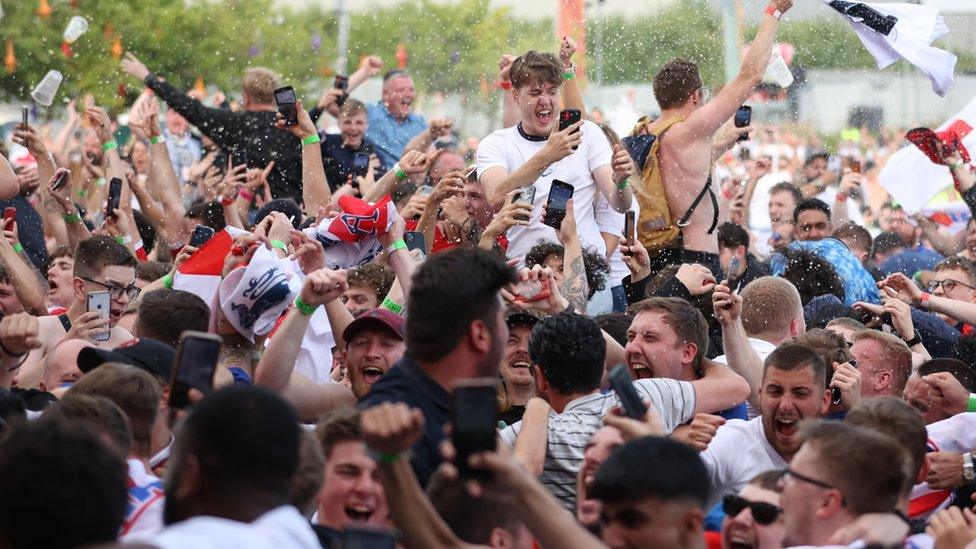
- Deindividuation is when you lose self-awareness in a group setting—think stadium crowds, pub celebrations, or high-stakes finals. In those moments, the emotional high makes it feel like you were there.
- This blurring of lines between observer and participant is why “we” rolls off the tongue so easily.
5. The Flip Side: When It’s “They”
- Ever noticed how quickly “we won” turns into “they lost”? That’s CORFing—Cutting Off Reflected Failure.
- It’s a self-protection strategy: keep the wins close, push the losses away. It’s not calculated; it’s subconscious.
Real Fan Perspectives
Even on Reddit, people can’t resist dissecting it:
“Basically, when an individual engages in BIRGing they associate themself with successful others, such that another’s success becomes their own.”
“They say that because subconsciously it is a tribe to them and not a team. It is the us or them mentality…”
And the critics are just as blunt:
“Seriously. What do you mean ‘we’? Did you train with them?”
So… Is It Harmless, or Is It Just Self-Indulgent?
Fans say “we won” not (usually) out of arrogance, but because sport taps into our primal need to belong, to share in success, and to attach our identity to something bigger than ourselves. Psychologically, it makes sense.
But language matters. And for me, “we won” still sparks an eye-roll (sorry!). If you didn’t kick the ball, row the stroke, or run the sprint you didn’t win. You supported. And that’s fine! Just call it what it is.
I’m not saying ban the phrase. I am saying reflect on why you use it. Is it genuine team spirit, or is it a quick dopamine hit of victory you didn’t actually earn?
No responses yet