
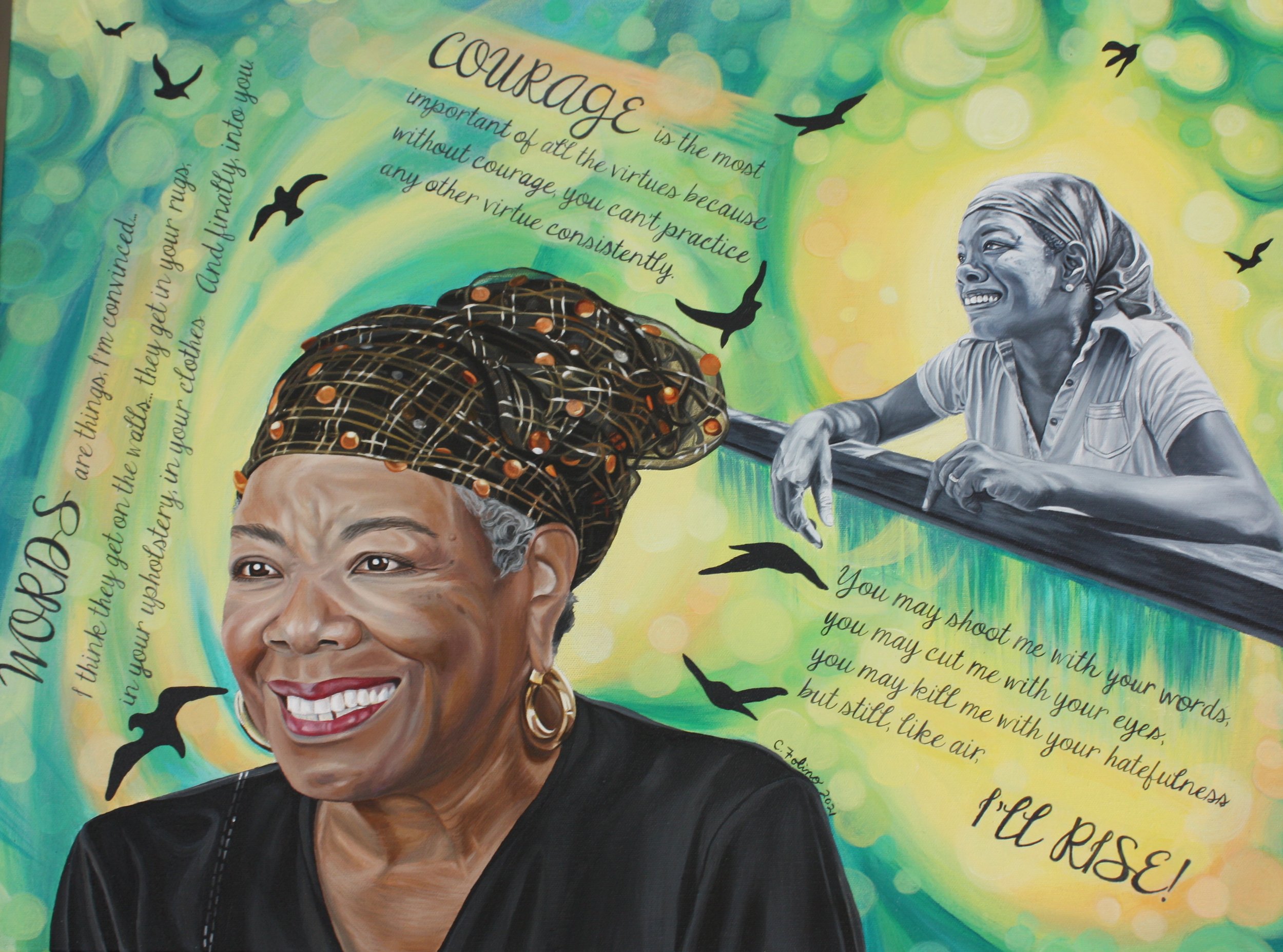
Exploring how the writers of “Still I Rise”, “The Necklace”, and “The Story of an Hour” present the female perspective.
Feminist writers throughout the centuries have reminded us of the conventions and quintessential qualities that men have given us and have defied these stereotypes through poetry, novels, short stories and more. These pieces of literature have invited a patriarchal society to reflect on the prejudices faced by women and have inspired people to acknowledge the power and strength of women instead of marginalising them as weak and subservient.
In Maya Angelou’s poem, “Still I Rise”, she presents herself to be determined in rising above the oppression and prejudices suffered by black women in the 1970’s. Angelou states that people “may write [her] down in history” and tell her story through a male perspective but throughout the poem she makes it clear that she remains relentless in giving their words any value. This is demonstrated through the use of the anaphora “you may”, which connotes that Angelou is aware and acknowledging that the oppressor- or alternatively, society- has the power and leverage to “cut… shoot… kill” her. Despite the tricolon of these active and violent verbs she still insists that her truth and spirit will overcome whatever falsehoods this prejudiced society spreads. In fact, Angelou places a strong emphasis on this point by rhyming the “bitter, twisted lies” with “but still, like dust, I’ll rise” in the first stanza; she is able to directly counter the lies of her oppressor with her rise and this reiterates her power and resilience regardless of the hardship’s society will throw at her.
Throughout the poem, Angelou constantly makes references to her femininity (and the strength of this femininity) through symbols and imagery linked to sexuality. Angelou compares herself to be “just like moons and like suns” and states that she is “a black ocean… welling and swelling”; both the metaphor and similes have typical connotations to feminism, with the moon representing the rhythm of time as it embodies our menstrual cycle and “welling and swelling” implying pregnancy, but also the“black ocean” reminding us of Angelou’s heritage and moreover, reinforcing the immensity (just like the ocean) of her muliebrity and strength. In addition to this, Angelou directly addresses the oppressor’s notions on femininity through the rhetorical questions “Does my sexiness upset you?” and “Does it come as a surprise that I dance like I’ve got diamonds at the meeting of my thighs?” – Implying that the problem society has with her lies with her having a sense of value, pride, and worth in who she is; by associating the “meeting of [her] thighs” with “diamonds” she’s placing the idea of wealth together with an intimate part of her and therefore is deepening her self-regard despite the distaste towards women being overtly confident in themselves and their sexuality. Angelou effectively manages to uplift the readers’ spirit through a literary work that has enormous potency in inspiring other (black) women to understand their inner strength and consequently empower them to remain strong against any tribulation they face in times where racism and sexism were prevalent.
Kate Chopin’s “The Story of An Hour” reveals how a female’s true strength can be revealed when liberated from a controlled environment or person. The main character of this short story, Mrs Louise Mallard, is a reflection of the gender roles seen in the eighteenth century; women were considered to be inferior and subservient to their male counterparts and were expected to oversee the many domestic duties in their household environment instead of having the liberty to be independent and do as they please. This is seen with Chopin’s initial presentation of Louise who conforms to a Victorian stereotype (“afflicted with heart trouble” – suggesting weakness and being “young, with a fair, calm face” reinforcing the expectations of a women’s beauty), but soon after her husband’s death we see her defying the expectations of subservience and realising that “there was something coming to her (…”through the sounds, scents, and colours”) and she was waiting for it, fearfully” before realising, after “abandon[ing] herself”, that it was freedom. The personification of freedom through sensory language makes the freedom even more powerful and consuming for Mrs Mallard and the exclamatory tricolon of “free, free, free!” that follows, shows the passion she has in accepting her widowhood because with it comes a newly born freedom that does not bind her to the conformations of a restraining marriage; this aberrant reaction reflects not only Louise’s opinion on
defying the acceptance of a biased and inequitable marriage but perhaps also a society of women’s opinions too. I believe Chopin tried to get an audience of women to understand that even though the ideas of a women’s inferiority are embedded deeply into a community, it doesn’t mean that these ideas are right and truthful and in fact, when removing oneself from these environments they can begin to truly comprehend their desires and realise they’re normal and deserved.
Similarly to “The story of an Hour”, Guy de Maupassant’s short story – “The Necklace”- presents us with a stereotypical 18th century bourgeois woman. Mathilde Loisel, the main protagonist of this story, is described to be “one of those pretty girls, delightful girls who, apparently by some error of Fate, get themselves born to the daughters of very civil servants”; the first lines of this text already establish that a woman’s importance was their beauty and social status or wealth. Mathilde “has no dowry, no expectations, no means of meeting some rich, important man who would understand” and therefore (like many other women at the time) has to rely on her “beauty, grace and charm” for she has “nor rank, nor class” to set her place in a patriarchal’s society hierarchy. This negative tricolon reveals a sense of hopelessness and impotence in her social position as she would’ve been highly restricted in her options to marry given that she wasn’t born of wealth. Furthermore, the triplet of “beauty, grace, and charm”, exhibits that great importance is placed on a woman’s surface attributions in order to do them “service for birthright and connections”. So, unlike a man, who would’ve been independent to rise up the hierarchy of social position, a woman is severely segregated in terms of social ladders given that she would be passive and dependant on the income of her husband to survive. I believe this is presented through Mathilde’s materialistic perspective on the world around her; the grandiose imagery and enumeration in Mathilde’s everyday desires of “silent antechambers hung with oriental tapestries”, “great drawing rooms dressed with old silk”, and “pretty little parlours […] made for intimate talk […] with one’s closest friends” show how possessing lavish items is her foremost desire, as she cannot be considered noble or important in any other way.
Mathilde’s hamartia is presented through her vanity and greed for objects out of her reach; her pride is the cause of her downfall which makes her go from a dissatisfied life to a true life of labour and manual suffering. From the very beginning of the text, Mathilde has been gluttonous and insatiable, always coveting to be “popular, envied, attractive, and in demand”, believing that “god had made her for such things”. Moreover, the lack of invaluable, substantial items doesn’t seem to bother her husband who you could argue is the antithesis of Mathilde; he contradicts Mathilde’s fanciful desires of “exquisite dishes”, whereas he thinks that “there’s nothing [he] likes better than a nice stew”. The exclamatory sentence “Ah! Splendid” juxtaposes his wife’s melodramatic views on their living conditions. Perhaps the way Mathilde is presented in a male dominated society as someone who is solely acquisitive, enticing and subservient, is quite stereotypical. However, it plays a vital role in the ironic and dramatic ending. When once she was described to be “pretty” and “delightful” with moments that felt as if she were “floating in a cloud of happiness” due to the “homage, admiration, and desire she evoked”, later, after a decade of arduous and taxing work trying to repay the debt of the lost necklace, she is said to “[look] old” as “she [has] turned into the battling, hard, uncouth housewife who rules working-class homes”. The adjectives used to describe Mathilde are now vulgar and lacking refinement or elegance which, according to this text, makes her less feminine. Therefore, there is a certain irony to the story; her desire to be wealthy (which is derivative of her desire to be approved in society) is actually the very cause of her downfall. Considering this, I think that Maupassant effectively shows how a woman’s views are shaped by the expectations and stereotypes of the patriarchal society she would’ve lived in; her belief that she was worthy of more in life due to her physical attributes, despite her lack of material objects, show that women are expected to place their attractiveness to a man as their highest priority, but Maupassant demonstrates how this over fixation on their appeal can be the cause of their nadir.
To conclude, these pieces of poetry and prose have all explored the female perspective in different ways: Maya Angelou focuses on realising the strength of muliebrity and rising above the oppression of this power; Kate Chopin highlights the ignorance men have of the desires women have for freedom and reveals the repressive nature of marriage for a woman; Guy de Maupassant portrays a divided social hierarchy in a patriarchal society and how a woman’s attitude and perception of the world is affected by this.
Comment closely on the writing in the final Chapter (16) of Remainder considering ways in which it demonstrates the styles and concerns of the novel as a whole.
Year 13 English Literature OCR A-Level Coursework : 94% Final Grade In Chapter Sixteen of Tom McCarthy’s ‘Remainder’, the[…]

“Kinship Defines the Heroic”. Compare the ways in which heroism is influenced by Characters’ relationships in Beowulf and Antigone
Year 12 English Literature OCR A-Level Coursework : 94% Final Grade In both Beowulf and Antigone, heroism is inseparable[…]

David Danced Before the Lord with All His Might
“David danced before the Lord with all his might.” – 2 Samuel 6:14 I’ve always loved this verse, though[…]
No responses yet