
Lately I’ve been pondering a small phrase that seems to carry a surprising amount of weight: “used to.” It came to mind as I’ve gradually begun returning to things that somehow slipped away in the general busyness of life – reading for the sake of it, swimming again, picking up small habits that once felt so instinctively part of who I was. Not that any of them disappeared fully, more so that they faded into the background as other obligations took precedence. But in returning to them I’ve noticed how often we describe past versions of ourselves using that curious phrase: I used to paint. I used to swim. I used to be in a relationship. I used to dream of being an astrophysicist. I used to be good at maths. It fascinates me because “used to” doesn’t just mark something as past; it often seems to carry a subtle sense of closure, as though the identity attached to the activity has been quietly sealed away.
This is particularly noticeable in the way we use the phrase to describe identities or roles, especially those that once felt central to our sense of self. People say I used to be a swimmer, I used to be a doctor, I used to be an artist, and the phrasing suggests that the title belongs exclusively to a previous life. Yet recently I’ve realised how odd that can feel. I still swim now – not twice a day as I once did, but a few times a week – and describing myself by saying I used to be a swimmer suddenly seems inaccurate. The phrase doesn’t simply place the activity in the past; it also attaches the identity to a particular intensity of the activity. In other words, it suggests that the title only truly belonged to me when swimming structured my days and defined my routine. Once that intensity diminished, the identity was apparently meant to vanish with it. But why should that be the case? If someone paints once a month they are still painting; if someone writes occasionally they are still writing. Yet we have a curious habit of believing that identities only belong to us at their most extreme or professionalised form, as though they must be justified by quantity before we can claim them.
Perhaps the problem lies in how we think about identity itself. We often imagine it as something fixed – a category we either inhabit or abandon – but it might be more accurate to understand it as something ongoing and active. Instead of thinking of ourselves as a being, defined by a static label, it may be more useful to think of ourselves as be-ing, something closer to a verb than a noun. Identity then becomes an activity rather than a possession. You are not a swimmer because of the hours you once spent in a pool; you are a swimmer because you swim. You are not a reader because you finished a hundred books one year; you are a reader because you read. In that sense, the parts of ourselves that we sometimes mourn as lost are often simply dormant, waiting to be reactivated through the act itself. I sometimes feel nostalgic for the swimmer I once was, for the version of myself whose life revolved around the water, but stepping back into the pool reminds me that the distinction between that person and the present version of me is not as absolute as the phrase used to be suggests. The identity has not disappeared; it has merely changed shape. What once felt like a closed chapter can reappear the moment we begin doing the thing again.
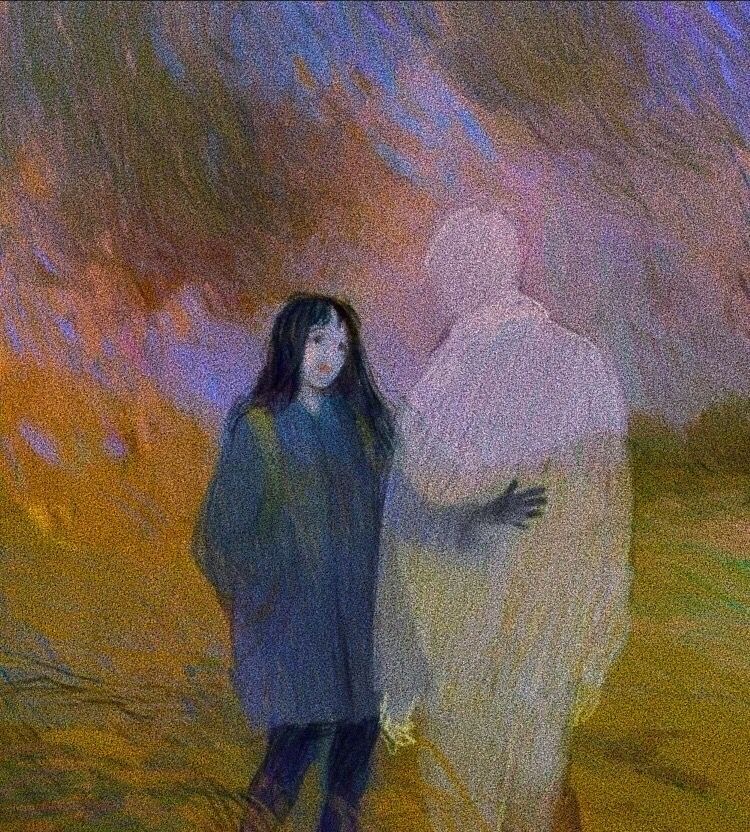
Yet there is another way we use the phrase used to, and this second usage carries a slightly different emotional texture. Instead of describing roles or activities, it often refers to emotional states: I used to be happy. I used to love him. When the phrase appears in this context it acquires a kind of ghostly quality, as though the feeling itself once existed vividly but now lingers only as a faint outline. Emotions, after all, are perhaps the most transient aspects of our lives. If one were to imagine them physically, they would seem almost translucent – something you might try to grasp only to find your hand passing straight through them. They appear with extraordinary intensity, linger for a time, and then gradually transform into something else entirely. Love can soften into memory or familiarity; grief can slowly evolve into acceptance; sadness can give way, almost unexpectedly, to relief or peace. Even the emotions we most desperately want to preserve rarely remain unchanged forever.
Because of this, the phrase used to often carries an implicit sense of loss. When someone says I used to love him or I used to be happy, the words seem heavy with the suggestion that something meaningful has slipped away. Yet the very existence of the phrase also reveals something beautifully hopeful about human experience: it proves that emotional states are not permanent. Just as love can fade, sorrow can also pass. Someone who once says I used to be so depressed may be speaking from a place of recovery; someone who mourns the loss of an old happiness may eventually discover a different form of it emerging in their life. Our emotional landscapes are constantly shifting, and although that instability can feel frightening when we are losing something we cherish, it is also the reason we are able to move beyond the feelings that hurt us.
Perhaps the beauty of the phrase used to lies in this dual meaning. On the one hand, it reminds us that parts of our past cannot be replicated exactly as they once were. But on the other hand, it also reveals how fluid and renewable human life actually is. Activities can be rediscovered, identities can be resumed, and emotional states can evolve into entirely new ones. The person who once said I used to paint might one day pick up a brush again; the person who believed they had lost their sense of joy might gradually find it resurfacing in unexpected places. Life rarely moves in perfectly straight lines. Instead it loops, revisits, and quietly returns us to things we thought we had outgrown or abandoned.
And perhaps that is why I’ve begun to think differently about the phrase altogether. Rather than seeing used to as a full stop – a neat boundary between who we were and who we are now – it might be better understood as a pause within a much longer sentence. The swimmer, the reader, the dreamer, the painter: these identities rarely vanish completely. They simply drift in and out of prominence as our lives expand and contract around different priorities. Sometimes all it takes to rediscover them is the simple act of beginning again.
Comment closely on the writing in the final Chapter (16) of Remainder considering ways in which it demonstrates the styles and concerns of the novel as a whole.
Year 13 English Literature OCR A-Level Coursework : 94% Final Grade In Chapter Sixteen of Tom McCarthy’s ‘Remainder’, the[…]

“Kinship Defines the Heroic”. Compare the ways in which heroism is influenced by Characters’ relationships in Beowulf and Antigone
Year 12 English Literature OCR A-Level Coursework : 94% Final Grade In both Beowulf and Antigone, heroism is inseparable[…]
David Danced Before the Lord with All His Might
“David danced before the Lord with all his might.” – 2 Samuel 6:14 I’ve always loved this verse, though[…]
Giulia
No responses yet