
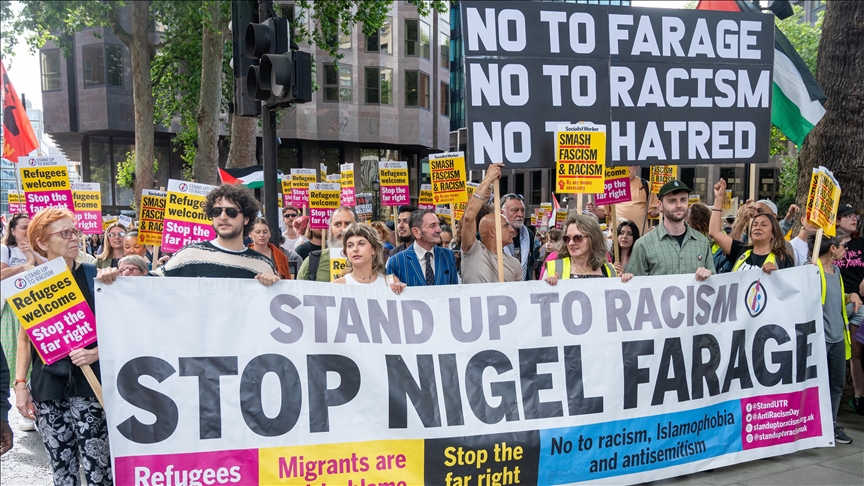
This post explores how everyday habits, choices, and conveniences – from the clothes we wear to the coffee we drink – are shaped by social and legal systems. It looks at how voting for a party like Reform UK can endorse a worldview that can make some of these ordinary freedoms and cultural exchanges seem contradictory.
No one is going to confiscate your jeans at the polling station. Nigel Farage is not hiding behind the ballot box with a clipboard and a cultural purity test. There isn’t a Reform militia waiting to revoke your reusable coffee cup. That’s not the point of this blog.
The point is subtler.
Voting is, by consequence, an endorsement of direction. Your vote carries implications beyond the slogan on the leaflet. Your vote affirms a worldview. And worldviews are, if you will, ecosystems: they create climates in which certain ideas, identities and cultural exchanges flourish – and others wither. If you vote for a party built on hard borders, protectionism and suspicion of “foreign influence,” you are backing a political environment that narrows, rather than expands, the flow of people and ideas. Everyday freedoms might remain technically legal. But the conditions that made them possible begin to feel contradictory.
So this blog is not about literal prohibition. It’s about compatibility. About tracing the logical threads between ordinary life and the political architecture that sustains it. If you vote Reform UK, you absolutely retain the legal right to do all the following things. The question is whether the ideas behind them survive comfortably under the platform you’ve endorsed.
You can’t wear jeans.
Not because anyone will arrest you. But because jeans are a product of precisely the kind of cultural mingling and labour history that nationalist purity politics treats as expendable. Denim trousers were popularised in the nineteenth century by Levi Strauss, a German Jewish immigrant in America, and were worn first by miners and labourers – many of them migrants – during the California Gold Rush. In the twentieth century, jeans became embedded in Black American culture, from blues musicians to the civil rights movement. They were later globalised through Hollywood, rock music, and youth subcultures across Europe and Asia. Today, they are stitched together by global supply chains spanning Turkey, Bangladesh, Pakistan and China.
So, my point is that jeans are not just trousers. They are migration, industrialisation, racial history, rebellion, global trade and cultural exchange, worn without a second thought for us today. When Nigel Farage argues that Britain should resist becoming a “multicultural society” and frames immigration primarily as dilution, he is critiquing the very processes that created the modern wardrobe. You cannot celebrate the aesthetic fruits of cultural interweaving while politically endorsing a programme that treats that interweaving as decline.
You can’t grab a flat white on your way to work.
No one is confiscating your takeaway cup. But the modern British coffee culture that feels so ordinary – independent cafés, latte art, the easy fluency with words like espresso and macchiato – is imported. Coffee originates in Ethiopia, spread through Ottoman trade routes and European ports, and the “flat white” arrived here from Australia and New Zealand. The beans are grown in Colombia, Brazil, Vietnam and Kenya; the cafés are often staffed or founded by migrants and second-generation Britons. As recently as the 1980s, Britain was largely a nation of instant coffee. The high street café – part office, part meeting place, part social hub – exists because people moved, traded, borrowed and settled here.
Nigel Farage has said that “multiculturalism has failed” and spoken about feeling “uncomfortable” hearing different languages on a train.
But the flat white in your hand is the sound of different languages.
It is supply chains, migration, borrowed tastes and adopted habits. If cultural mixture is framed as something horrific, then so is the everyday diversity that stocks the shelves, runs the cafés and reshapes what we consider normal. You can enjoy the result. But you are voting for a politics that treats the process behind it as the problem.
You can’t cheer for the Premier League and complain about foreigners in the same breath.
The Premier League is a globalised spectacle: international players, international owners, international audiences. From Mohamed Salah to Son Heung-min, the league’s stars are migrants whose talent and labour enrich British cultural life and generate billions in revenue for our country. The shirts are manufactured abroad. The broadcasting rights are sold worldwide. To treat migration as a net cultural threat while celebrating one of the country’s most visible globalised industries is just incoherent to me.
You can’t post about mental health awareness and vote for a party committed to shrinking the state.
Public campaigns around mental health, domestic abuse and community wellbeing rely on infrastructure: NHS services, council funding, publicly supported charities. Reform UK’s economic posture is oriented toward reducing the size of the state and lowering taxation. That may be a legitimate ideological position. But it sits uneasily beside the expectation that the safety net will quietly remain intact. You cannot meaningfully valorise “community” while stripping back the institutions that make communal care possible.
You can’t rely on fair treatment at work or in shops without the Equality Act.
It seems mundane: walking into a café, signing up for a gym class, or applying for a promotion. Most people assume these moments are automatically fair and that the barista won’t refuse service because of your race, the gym won’t block someone in a wheelchair, and your boss can’t dismiss you for being pregnant or gay. These are small, everyday interactions, but they are legally protected by the Equality Act. Just last year, for example, a woman returning from maternity leave successfully reclaimed her role and pay after her employer tried to downgrade her position – a protection she would not have had if the law were repealed.
You can still grab your latte or sign your contract. But the Equality Act is what quietly guarantees that those moments aren’t left to chance. Without it, the baseline assumption of fairness – that your gender, race, or sexuality won’t suddenly shape how you are treated – becomes uncertain. What feels ordinary, effortless, and just “the way things are” depends on the legal scaffolding most people barely notice.
And you can’t insist that culture is detachable from policy.
Because culture is policy. The music charts, the high street, the food scene, the football league, the language itself – all of it is sedimented history. Empire, immigration, trade, diaspora, resistance, borrowing. To vote for a politics that frames these processes primarily as loss is to create friction with the life you are already living. Not because you are forbidden from enjoying it. But because you are voting against the continuation of the forces that produced it.
This is not an argument that borders should not exist, or that immigration policy should be limitless. It is an argument about honesty. If your frustration is economic stagnation, housing shortages or political scandal, then say that. But recognise that voting for a party whose core identity is cultural retrenchment carries broader implications and ultimately you are endorsing a narrower definition of national belonging.
So no, you can wear jeans. You can eat curry. You can stream American music and cheer an Egyptian striker. The law will not stop you.
The question is whether your vote quietly pulls against the very currents that made those things feel effortless, British and unremarkable in the first place.
Think about the implications of your vote.
Comment closely on the writing in the final Chapter (16) of Remainder considering ways in which it demonstrates the styles and concerns of the novel as a whole.
Year 13 English Literature OCR A-Level Coursework : 94% Final Grade In Chapter Sixteen of Tom McCarthy’s ‘Remainder’, the[…]

“Kinship Defines the Heroic”. Compare the ways in which heroism is influenced by Characters’ relationships in Beowulf and Antigone
Year 12 English Literature OCR A-Level Coursework : 94% Final Grade In both Beowulf and Antigone, heroism is inseparable[…]

David Danced Before the Lord with All His Might
“David danced before the Lord with all his might.” – 2 Samuel 6:14 I’ve always loved this verse, though[…]
GIULIA
No responses yet