
Adaptation, Eroticism, and Audience Responsibility: This article is an exploration of what happens when we miss the point
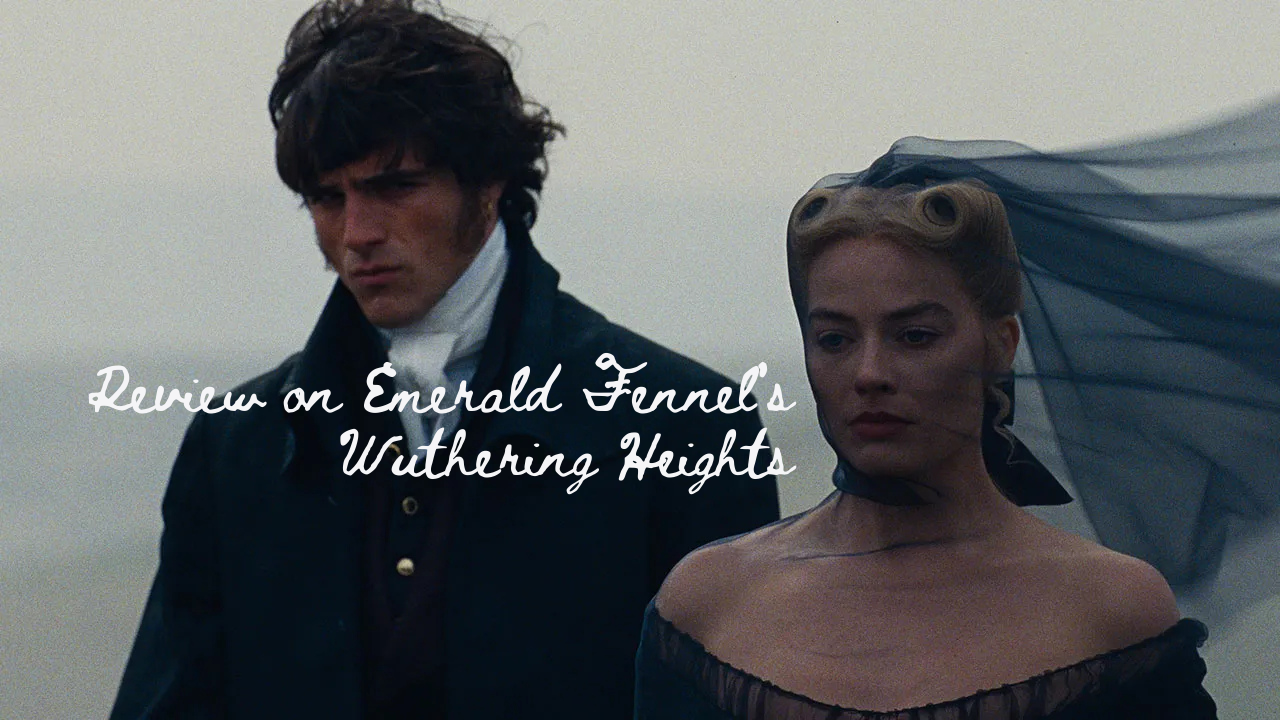
It’s been a week since ‘Wuthering Heights’ hit cinemas, and the dust has just about settled – or at least thickened into discourse. Emerald Fennell’s adaptation of Wuthering Heights by Emily Brontë has split audiences almost cleanly in two: those who think it’s a reductive, hyper-sexualised distortion of a Gothic classic, and those who think it’s a bold reinterpretation that dares to disturb.
Predictably, a large portion of the criticism has come from people who already know and love the novel. People who understand what it meant in 1847, how formally strange it is, how resistant it is to being called a “romance” at all. I think I would include myself in that camp. I read it years ago from a battered library copy and, after seeing the film, went straight out and bought my own edition to re-read. The preface in mine is by critic Lucasta Miller, who describes Catherine and Heathcliff’s relationship as “a quasi-incestuous, oddly unerotic relationship, more Romantic than romantic.” That distinction – Romantic versus romantic – feels central to the backlash of this adaptation.
Lucasta Miller is pointing to something easy to forget in 2026. The “Romantic” tradition Brontë writes within is Gothic, metaphysical, preoccupied with the sublime and the destructive. It is not primarily about yearning glances and aching desire. It is about possession, spiritual entanglement, ego annihilation. Modern romance, by contrast, tends to foreground heat – longing, sensuality, physical magnetism. A kind of almost aestheticised obsession. And Fennell’s adaptation leans unapologetically into that contemporary register.
For many readers, that feels like betrayal. In the novel, Catherine and Heathcliff’s connection is visceral but curiously un-eroticised. From memory, their love is declared in metaphysical terms – “I am Heathcliff” – rather than expressed through physical consummation. It is elemental, not sexualised. So when this adaptation amplifies the bodily, when it markets itself through sensual chemistry and visual intensity, some viewers feel it has slipped into something closer to “AO3 fanfiction” than Brontë.
I understand that reaction. I really do. I am, by nature and by degree, suspicious of adaptations that sand down complexity in favour of spectacle. But I also think we have to be careful about what we mean when we say a film “lacked substance.” Because adaptation is not transcription. Cinema is not a delivery service for plot points. It is an art form in its own right, with its own grammar and its own audience.
You don’t lift a painting out of an art history textbook and glue it unchanged onto a new canvas. You reinterpret it. You distort it. You reframe it in a different light. And if we walk into an adaptation clutching our private, interior version of a book – the Heathcliff we’ve constructed, the cadence of dialogue we’ve imagined, the exact shade of moorland sky – we risk rejecting anything that doesn’t match it before we’ve even asked what it’s trying to do.
Which brings me to the opening scene of the movie. Because I haven’t been able to stop thinking about it.
The film begins in darkness. Not atmospheric moorland darkness, but a black screen. Silence in the theatre. Then a man’s voice – groaning. It is strained, ambiguous, hovering uncomfortably between pain and pleasure and ecstasy. The sound continues long enough for you to settle on an interpretation. The assumption, conditioned by both cinema and marketing, is eroticism. And then the image appears: a public hanging. A man suspended, dying, as a crowd gathers to watch.
Children stare up. One boy points and says humorously, “He’s got a stiffy.” The other children laugh.
When I first watched it, I found the modern vernacular jarring, or at the very least random. Why that phrasing? Why that detail? Why begin here? It felt almost gratuitous. But the more I sat with it, the more it felt like a deliberate mirror held up to the audience.
A man is being executed – likely the victim of poverty, class transgression, systemic violence. A life ended in public spectacle. And the children’s focus narrows immediately to something sexual, something titillating, something easy to mock while the structural horror becomes background noise.
Now consider how much of the conversation around this film has fixated on its eroticism. On chemistry. On how “steamy” it is. On whether it’s too explicit. The marketing certainly leaned into that angle. But I can’t help wondering whether Fennell knew exactly what she was doing with that opening: priming us to expect sex, then confronting us with death. Forcing us to sit with our own reflex to eroticise before we understand.
I’m not claiming access to her private intentions. But as a piece of cinematic rhetoric, it’s sharp. It suggests that what we look at – what we choose to see – matters. A person is hanging, and we’re laughing at the stiffy. There are class systems, racial hierarchies, and gender constraints operating throughout this story, and yet the discourse keeps circling back to the sex.
“At this time, the feelings they had for each other, … out of wedlock.. And with the class system was impossible.. So it was really important that we understood how troubling feelings are for Cathy and how dangerous stepping over those boundaries is… she wouldn’t just, COULDN’T JUST, yield.”
In interviews, Fennell has spoken explicitly about class and social impossibility. She’s discussed how, at that time, Catherine’s feelings were dangerous and structurally unsustainable. To love across class lines was to risk annihilation. Marriage was not primarily about romance; it was about security, survival, consolidation. Catherine cannot simply yield to Heathcliff because the system will not permit it. The tension then between desire and social law is very much present in the film, even if it’s not always articulated through Victorian exposition.
And then there’s Isabella. For me, she is the clearest example of why the “it’s all just sex” criticism misses something crucial. There is a scene in which Heathcliff tells her, coldly, that he does not love her. That he will use her. That he will sleep with her while thinking of Catherine. It is not seductive. It is humiliating. It is, frankly, a declaration of emotional violence. And in my screening, people laughed the whole time. Isabella tries to hold herself together, she nods, she maintains posture, but there is a realisation that she is not chosen – only convenient. And she is certainly not loved.
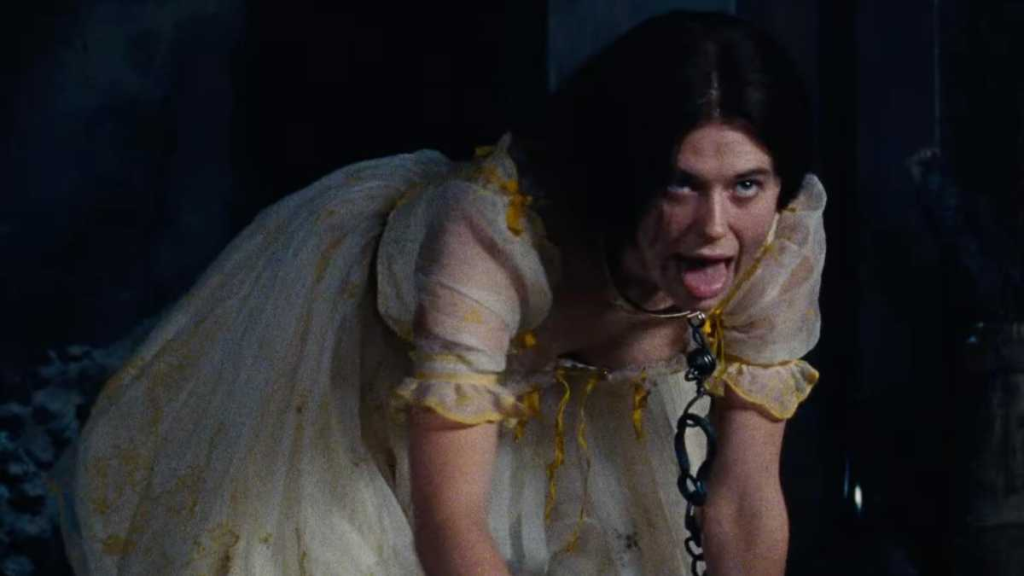
In the novel, Heathcliff’s cruelty is rendered grotesquely literal when he hangs Isabella’s dog. It is an act so blunt and violent that it obliterates any lingering temptation to romanticise him. There is no aesthetic distance in that scene. It forces clarity for the reader and makes us face Heathcliffe for who he truly is. Fennell makes a deliberate choice not to include it. Instead, she replaces that act with something perhaps more psychological and symbolically charged: Isabella herself is made to occupy the dog’s position. She lowers herself and performs obedience. The degradation is hence enacted on her, rather than the dog.
And again the audiences laughed.
I do not think that reaction is accidental or meaningless. In fact, I think it reveals precisely why the change matters. If the film had shown Heathcliff hanging the dog, the mood in the cinema would likely have shifted instantly to horror. That type of cruelty most likely would have produced an immediate and uncomplicated revulsion in modern viewers. It would have sealed Heathcliff’s brutality in a way that could not be softened or stylised. But by transferring the violence from animal to woman, the scene enters a more ambiguous register. The cruelty becomes something audiences can process as uncomfortable excess rather than explicit atrocity. In other words, it becomes more palatable.
Watching a dog die would collapse the romantic fantasy of Heathcliff too decisively. Watching a woman degraded allows some viewers to maintain it. The Byronic anti-hero survives if the harm inflicted can be reinterpreted as provocative or stylised.
This is why I struggle with the claim that the film lacks substance. The substance is not absent; it is embedded in scenes like this. The question is whether we are prepared to read them as indictments rather than titillation. When audiences laugh at Isabella but would recoil at a dead dog, it suggests a hierarchy of empathy that the film is, perhaps deliberately, exposing.
So when people argue that the adaptation reduces the story to sex, I find myself wondering whether that reduction originates in the film or in the viewer. The degradation of Isabella is not erotic in any uncomplicated sense; it is an illustration of power operating through intimacy. It is about ownership disguised as romance. If we interpret it as shallow provocation, we may be choosing the most comfortable reading available – one that allows Heathcliff to remain aesthetically compelling rather than morally troubling.
None of this is to say the adaptation is flawless. It truncates the novel, ending before the later generational arc unfolds. It omits Heathcliff’s graveyard obsession, the exhumation that pushes the Gothic into the macabre. Interestingly, Fennell’s earlier film, Saltburn, includes a grave scene that many noted echoed Wuthering Heights. Here, she resists that temptation. By cutting short, she avoids the spectral transcendence of the novel’s final movements and instead traps us in the suffocating immediacy of social constraint. There is no softening through time, no pastoral reconciliation. Just the raw consequences of desire colliding with structure.
Some viewers may miss the layered narrative frame of the book- Lockwood, Nelly, the distancing effect of storytelling within storytelling. I do too. But the absence of those devices does not automatically equal absence of theme. It means the themes are being communicated differently.
What fascinates me most is how quickly audiences reduce Fennell’s work to its most sensational elements. Saltburn became “the bathtub film” online, its commentary on elitism and class parasitism flattened into shock-value clips. I can’t help feeling something similar is happening here. The eroticism goes viral; the systemic critique fades into the background.
So yes, I understand why some Brontë purists feel protective. I share the instinct. The novel remains colder, stranger, and in many ways more devastating. But to say the film “lacks substance” seems to me reductive. It may not foreground the same aspects of the text in the same proportions, but it is clearly thinking. Clearly engaging. Clearly provoking.
If you wanted a line-by-line recreation, the book still exists. It hasn’t been altered by this adaptation. But cinema is allowed to adapt – to refract, to modernise, to challenge the way we consume stories. And whether you loved or hated this version, it has undeniably forced a conversation about what we expect from “romance,” about what we notice, and about what we overlook.
So I’ll end with this: when the screen went black and the groaning began, what did you assume you were about to see? And when the man was revealed, hanging, what did you focus on?
I’d genuinely love to know where you land. Have I shifted your view at all? Or are you still firmly on the moors, defending Brontë? Thank you for reading.
Comment closely on the writing in the final Chapter (16) of Remainder considering ways in which it demonstrates the styles and concerns of the novel as a whole.
Year 13 English Literature OCR A-Level Coursework : 94% Final Grade In Chapter Sixteen of Tom McCarthy’s ‘Remainder’, the[…]

“Kinship Defines the Heroic”. Compare the ways in which heroism is influenced by Characters’ relationships in Beowulf and Antigone
Year 12 English Literature OCR A-Level Coursework : 94% Final Grade In both Beowulf and Antigone, heroism is inseparable[…]

David Danced Before the Lord with All His Might
“David danced before the Lord with all his might.” – 2 Samuel 6:14 I’ve always loved this verse, though[…]
GIULIA
No responses yet