

Art has always been a profound vehicle for human expression, with each era building upon the foundations of its predecessors. Ancient art, encompassing the works of early civilizations, has left an indelible mark on the evolution of artistic expression, inspiring numerous artists across different periods. In this article, I aim to explore how ancient pieces of art has shaped not only Renaissance masters like Botticelli and Michelangelo but also modern icons such as Van Gogh and Picasso. By examining the continued influence of ancient art, we gain insight into the power of classical themes, forms, and techniques in the evolution of modern art.
Modern art is a broad term that typically encompasses artistic works produced from the late 19th century to the mid-20th century, though its influence extends into contemporary art. Unlike previous movements that adhered strictly to realism and conventional techniques, modern art breaks from these traditions by embracing abstraction, innovation, and symbolism. Modern artists sought to represent the world in new ways, often challenging societal norms and exploring new materials and techniques.
However, while modern art is marked by its departure from tradition, it is also deeply influenced by ancient art. Many modern artists drew inspiration from ancient forms, incorporating classical symbols, mythological themes, and even ancient artistic techniques into their work. This duality of rejecting and embracing the past is central to modern art’s development, demonstrating that innovation often arises from an intimate relation with history.
The Renaissance, a cultural revival spanning from the 14th to the 17th century, was characterized by a renewed interest in the art and philosophy of ancient Greece and Rome. This period saw artists like Botticelli and Michelangelo engage deeply with classical ideals, effectively laying the groundwork for future artistic movements, including modern art.
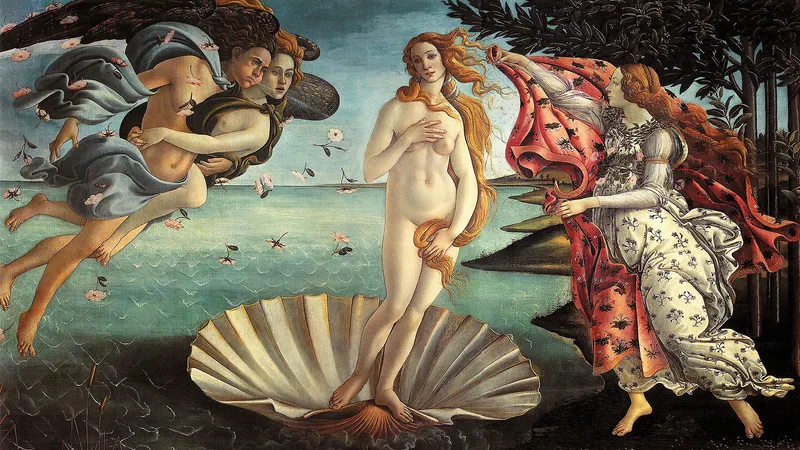
Botticelli’s The Birth of Venus, painted in the late 15th century, is a prime example of Renaissance art drawing directly from ancient mythology. This painting illustrates the classical myth of Venus’s birth, as recounted in various ancient texts, including those by the poet Hesiod. According to the myth, Venus, the goddess of love and beauty, was born from the sea foam after the god Uranus was overthrown, and his severed genitals fell into the ocean. In The Birth of Venus, Botticelli captures the moment when Venus emerges fully grown from the sea on a giant shell, carried ashore by the winds, represented by the figures of Zephyr and Aura.
The portrayal of Venus reflects classical ideals of beauty and symmetry, which were highly valued in ancient Greek and Roman art. In this painting, Botticelli presents Venus with an elongated neck, flowing hair, and graceful, almost impossible proportions that reflect an idealized rather than realistic depiction of the human form. Her pose is reminiscent of the classical contrapposto stance, with her weight shifted onto one leg, creating a sense of natural elegance and fluidity. Additionally, her hands and hair delicately cover her modesty, mirroring ancient sculptures of Venus that embody both sensuality and chastity.
The depiction of Venus as both a symbol of physical beauty and an embodiment of divine love suggests that earthly beauty can inspire a spiritual ascent towards the divine. And essentially, by drawing from ancient myths and ideals, Botticelli created a work that resonates with a timeless sense of harmony and effectively blends the aesthetic sensibilities of ancient Greece with the symbolic depth of Renaissance spirituality and their Neoplatonic philosophy.
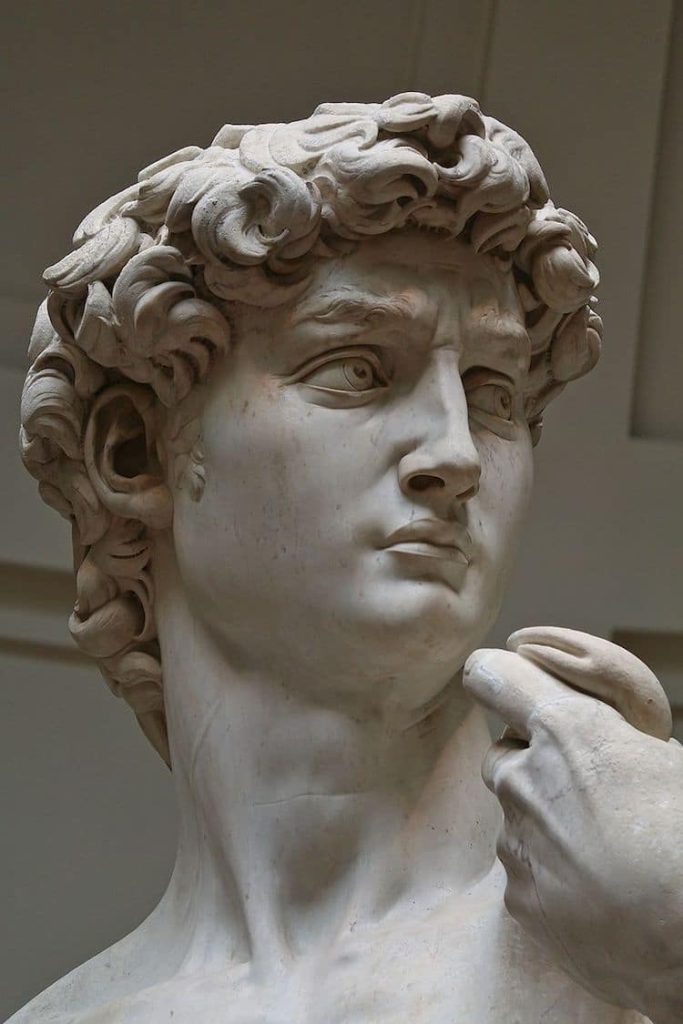
Michelangelo’s David is an iconic Renaissance sculpture that captures the biblical hero David at the moment before his battle with Goliath. In the Old Testament, David, a young shepherd, defeats the giant Goliath with a single stone from his slingshot, symbolizing the triumph of intellect and courage over brute strength. This story was a popular subject in Renaissance art, representing the ideal of the hero who embodies both physical beauty and moral virtue.
Michelangelo’s David is particularly significant because it reflects a deep engagement with ancient Greek and Roman sculptural techniques and ideals. Standing at over 17 feet tall, David’s form is sculpted with an incredible level of anatomical accuracy, showcasing Michelangelo’s meticulous study of the human body. The statue’s musculature, veins, and pose are all reminiscent of classical Greek statues, especially those from the High Classical period, such as the Doryphoros by Polykleitos. The contrapposto stance (as seen with Botticelli’s work too), with David’s weight resting on one leg while the other is relaxed, creates a sense of movement and balance that was a hallmark of ancient Greek sculpture.
Furthermore, David’s facial expression, which combines alertness with a serene confidence, evokes the ancient Roman concept of “gravitas”—a dignified seriousness that conveys strength and moral purpose. This portrayal of David as both a physically idealized and intellectually focused figure reflects the Renaissance belief in the harmony of body and mind, an idea rooted in ancient Greek philosophy. By drawing from these classical influences, Michelangelo not only paid homage to ancient art but also redefined the heroic ideal for his own time, creating a symbol of Florence’s civic pride and resilience.
These detailed elements in Botticelli’s and Michelangelo’s works illustrate how deeply ancient art shaped Renaissance ideals of beauty, heroism, and harmony, showing a direct connection between classical themes and the humanist values that defined the era; by reconnecting with ancient art, they set a precedent for the generations of artists who followed, encouraging them to draw from the past while pushing the boundaries of their own creative expression.
Moving forward to the 19th century, Vincent van Gogh represents another key figure who drew inspiration from ancient art, albeit in a less direct manner. Van Gogh was deeply influenced by Japanese art, which, while not ancient in the Western sense, reflects an aesthetic tradition that dates back over a thousand years. Japanese art, particularly woodblock prints, had a profound impact on Van Gogh’s work, influencing his use of colour, composition, and subject matter.

Vincent van Gogh discovered Japanese woodblock prints, or ukiyo-e, during his time in Paris in the late 1880s, when these prints became popular among European artists. Van Gogh was captivated by the bold lines, vibrant colours, and simplified forms characteristic of ukiyo-e, which presented a stark contrast to the realism of Western art. He began collecting these prints and studied them intensely, even creating some direct copies as he sought to understand their techniques.
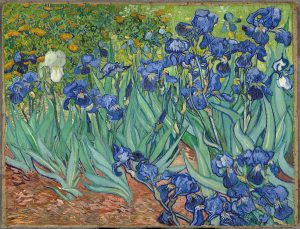
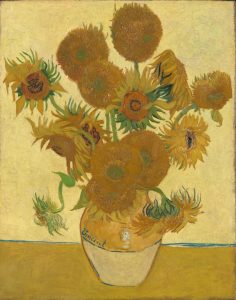
The influence of Japanese woodblock art is evident in Van Gogh’s Irises and Sunflowers, where he adopts a similar use of flattened perspective and strong outlines that distinguish each flower with clarity and vibrancy. In these works, Van Gogh reduces the details of individual petals and leaves to emphasize their overall shape and colour, drawing from the Japanese aesthetic of stylized natural forms. He also arranges the flowers in a way that creates a rhythmic, almost meditative pattern, echoing the balanced compositions typical of the woodblocks.
Moreover, the subject matter itself reflects the cyclical nature of life, a theme deeply embedded in both Japanese art and Van Gogh’s work. In Irises and Sunflowers, Van Gogh captures flowers in various stages of bloom and decay, symbolizing the fleeting beauty of life and the inevitability of change. This perspective mirrors the Japanese concept of “mono no aware,” or the awareness of impermanence, reinforcing the influence of Japanese aesthetics on his perception of nature and his approach to art.
By integrating these ancient motifs into his work, Van Gogh created paintings that feel both timeless and distinctly modern. His engagement with ancient themes, compounded with his innovative technique, showcases how the past can inform and enrich the present.
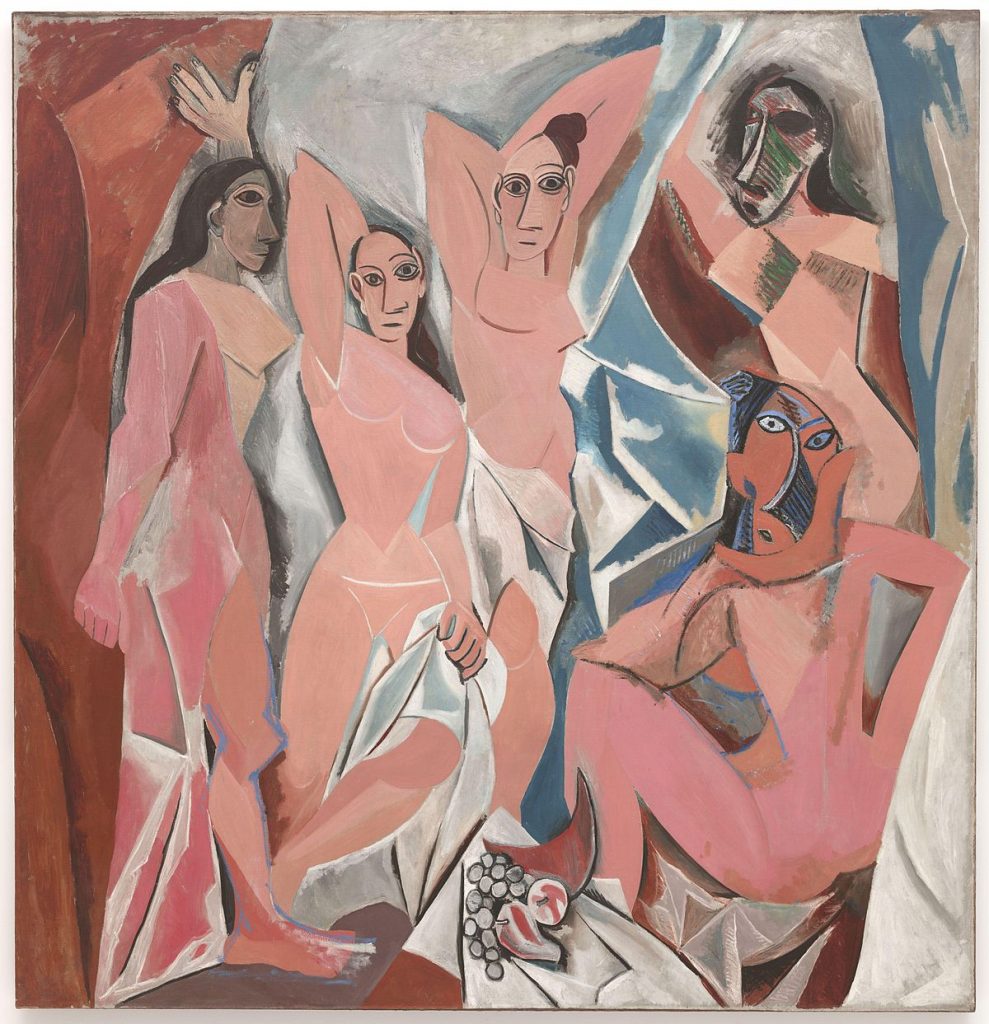
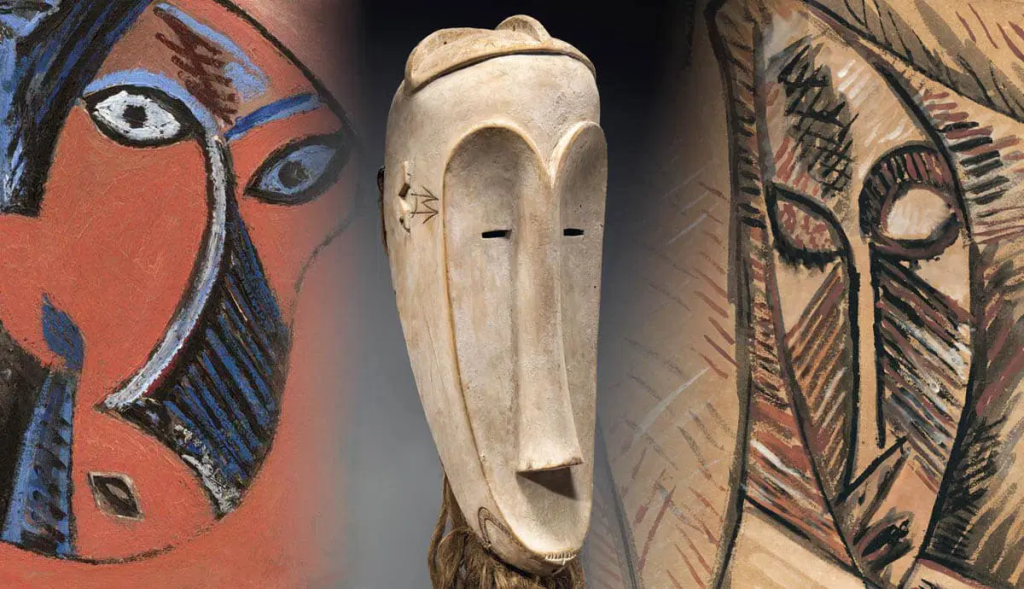
Pablo Picasso’s work was significantly shaped by his exposure to ancient art, particularly African masks and Iberian sculptures. These influences, which he encountered in Paris in the early 20th century, directly impacted his departure from traditional European realism and his development of Cubism. Picasso was fascinated by the abstraction and symbolism in these ancient forms, which allowed him to experiment with representing the human figure in new ways.
In Les Demoiselles d’Avignon, Picasso draws heavily from African masks and Iberian sculptures. The faces of two women are stylized with exaggerated, angular features that echo African masks. These masks, which are often symbolic and spiritual in their cultural context, present the human face in a way that emphasizes abstract forms over realistic detail. Picasso also incorporated elements of Iberian sculpture, which he studied extensively. The simplified, geometric facial features seen in Iberian statues are apparent in his depiction of the other figures, moving away from naturalism and towards an essentialized, almost raw representation of form.
By integrating these ancient influences, Picasso broke sharply with Western artistic conventions. He was not interested in portraying beauty or realism but in capturing a more primal, elemental aspect of the human figure. Les Demoiselles d’Avignon marked a radical shift from the realistic and idealized figures typical of Western art at the time. This work sparked controversy and faced criticism from those who found it harsh and unsettling. Picasso’s style challenged the viewer, asking them to look beyond conventional aesthetics and confront a fragmented, abstracted view of reality. However, Picasso’s use of ancient and non-Western influences has also drawn criticism for its cultural appropriation. While Picasso integrated these forms into his work, he often did so without a deep understanding of their cultural significance. This has led some to question the ethics of his borrowing, especially from African art, which he used to push the boundaries of his own work but without fully engaging with the cultural contexts from which these forms originated.
Despite these critiques, Picasso’s synthesis of ancient influences was pivotal in the development of modern art. His abstracted approach to the human figure, inspired by ancient forms, laid the groundwork for Cubism and contributed to a broader movement that questioned the nature of representation in art. Picasso’s legacy illustrates how ancient art can inform modern aesthetics in transformative ways, challenging traditional artistic norms and offering new perspectives.
The influence of ancient art on modern art is not limited to individual artists like Van Gogh and Picasso. Many modern art movements, including Surrealism and Abstract Expressionism, drew from ancient symbols, mythologies, and motifs. For example, Surrealist artists like Salvador Dalí often incorporated ancient mythological themes into their works, blending them with dreamlike and fantastical elements. This fusion of ancient and modern imagery created a sense of timelessness, reflecting the enduring relevance of ancient symbols in the human psyche.
Similarly, Abstract Expressionists such as Jackson Pollock and Mark Rothko engaged with the primal and archetypal qualities of ancient art. Pollock’s drip paintings, with their emphasis on raw emotion and spontaneity, evoke the ritualistic and symbolic art of ancient cultures, such as Native American sand paintings. Rothko’s colour field paintings, with their meditative quality, can be seen as a modern interpretation of ancient spiritual iconography, inviting viewers to engage with universal themes of existence and transcendence.

By incorporating ancient symbols and techniques into their work, modern artists created a dialogue between the past and the present, demonstrating how ancient art continues to inform and inspire contemporary aesthetics.
The influence of ancient art extends beyond the modern art movements of the 20th century and can still be seen in contemporary art today. Digital artists and installation artists frequently draw from ancient themes and symbols, using new media to reinterpret classical motifs for a modern audience. For example, contemporary artists might use 3D modeling software to recreate ancient sculptures or use virtual reality to immerse viewers in ancient landscapes. Ancient mythologies and archetypal symbols continue to resonate in contemporary art, as artists explore themes of identity, spirituality, and the human condition. The timelessness of ancient art provides a rich source of inspiration for artists who seek to connect with something enduring and universal.
In conclusion, the influence of ancient art on modern art is profound and far-reaching, spanning from the Renaissance to contemporary art. Artists like Botticelli and Michelangelo revived classical themes, while Van Gogh and Picasso reinterpreted ancient motifs in ways that transformed the trajectory of modern art. The continued presence of ancient symbols, techniques, and themes in modern art demonstrates the timeless nature of these early forms of expression and their capacity to speak to universal aspects of the human experience.
As we look to the future, the influence of ancient art will undoubtedly continue to shape the evolution of artistic expression, reminding us that while art may change with the times, its roots in history remain a constant source of inspiration. By embracing both the past and the present, artists can create works that are not only innovative but also deeply connected to the enduring legacy of ancient art.
David Danced Before the Lord with All His Might
“David danced before the Lord with all his might.” – 2 Samuel 6:14 I’ve always loved this verse, though[…]
Manspread
PREVIEW: “let it be known that change should be made with confidence – with the decision to remain where[…]

Liquid Assets
How Rising Fuel Prices Are Driving War Profits and Hitting Our Wallets Some of you have probably heard me[…]
No responses yet