
The Hidden Bias in Everyday Designs
Every day, women lace up shoes, buckle seatbelts, strap on gear and trust that these things are made to protect, to support, and to perform. But all too often they’re built for someone else: a default male body, male measurements, male assumptions. That mismatch has real consequences in terms of discomfort, higher injury rates, and worse outcomes in car crashes. This post will look at how sports equipment, especially shoes, safety gear and car restraints often assume male physiology and what the research says about the risks this causes.
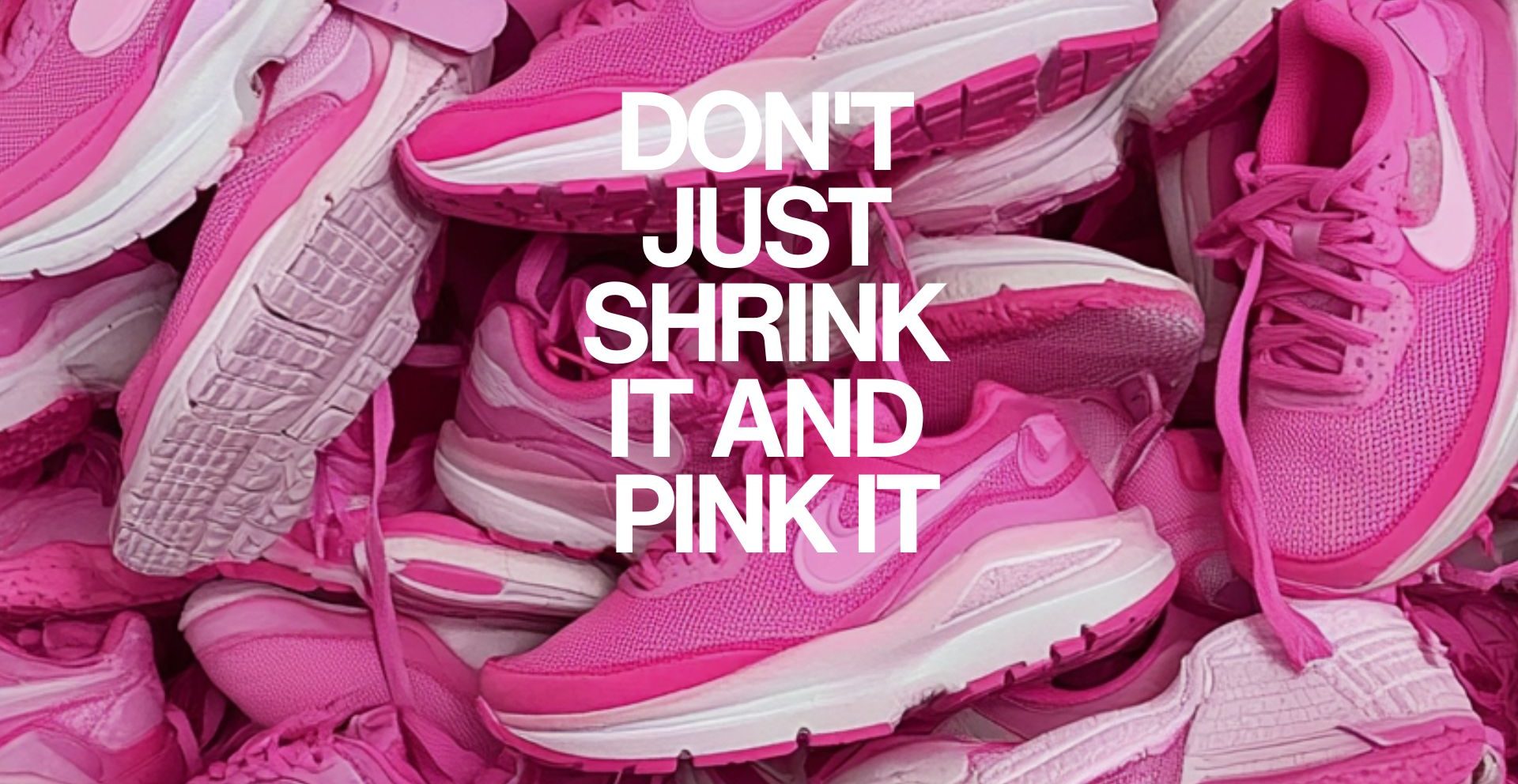
THE “SHRINK IT AND PINK IT” FALLACY
One of the clearest everyday examples is footwear. Many sports shoes, cleats, and boots are simply scaled-down versions of men’s designs, sometimes with colour changes but little else to accommodate anatomical differences in foot shape, biomechanics, weight distribution or how women move. A recent study of female rugby players, which scanned about a thousand feet and surveyed 330 players, found that 89% of them experienced pain from boots designed for men. Foot shape differences matter because women tend to have narrower heels relative to their forefoot, different arch geometry and different pressure zones. When studs or cleats are placed where male studs are, pressure points can form under areas of the foot that female feet may not structurally tolerate as well. In the rugby boots example, about 45% of the players reported pain under the first metatarsal- often where a stud is placed in a boot designed primarily for male feet.
There are injury consequences too. A review and meta-analysis of foot and ankle sports injuries in professional and semi-professional athletes found that female athletes have significantly higher rates of foot and ankle injuries compared with their male counterparts, with an odds ratio of about 1.52- roughly a 50% higher risk for females in many contexts. Another large study found that women are between three- six times more likely than male football players to suffer ACL injuries. One UK parliamentary report cited this as one of the concerns and connected it to equipment, especially boots, that are not designed with female biomechanics in mind. These are just a few examples, but they point to systemic neglect where differences in weight, joint structure, and movement patterns are often not built into the design phase. What exists instead is a “male standard” or “scaled male” standard.
CAR SAFETY, SEATBELTS.
If footwear is where performance and comfort get compromised, car safety is where mismatch can be life-threatening. Women are 73% more likely than men to suffer serious injury in a frontal car crash- they are also 17% more likely to die in such crashes. Several physical differences contribute to these disparities; women are, on average, shorter and lighter; they have different torso-to-leg ratios, pelvis shapes and centres of gravity. Women also tend to have less upper body mass and neck muscle, which affects how forces are transmitted in a crash- for example, increasing the risk of whiplash or head accelerations. This means that in some common crash types, women are more susceptible to certain sorts of injuries. Yet many safety tests have historically failed to represent this.
For decades, crash testing has been done using dummies that represent an “average male” adult- often referred to as a 50th percentile male. That means many car safety features such as seatbelt anchors, airbags and seat design are optimised for that body size. The female dummy that is sometimes used is often a scaled-down version of the male dummy, which does not adequately account for many female body differences such as shape of pelvis, proportions of torso or spinal alignment. In many cases this “female” dummy represents the 5th percentile woman as defined by standards from decades ago (a small, light woman) rather than the average. Astrid Linder and colleagues in Sweden have developed a dummy based on the average female body, about 162 centimetres tall and 62 kilograms, but many existing female dummies are much smaller and many crash safety protocols still do not mandate using them or require testing for female bodies in all relevant positions.
Seatbelt geometry illustrates how these standards translate into risk. Lap belts and shoulder belts anchor points are often optimised for male anatomy and for women, especially those of average height, belts might ride up, cross softer parts of the body or fail to restrain properly in a crash. This increases risk of injury to the lower abdomen, breasts and ribs. Because women are often shorter, they sit closer to steering wheels or dashboards. Sometimes seat adjustments in height and distance are more limited, which means in crashes the distance between body and safety components such as airbags and steering columns can put women at a disadvantage. Lack of neck and torso strength also makes women more susceptible to certain injuries in frontal or rear impact crashes.
BEYOND SHOES AND CARS
This male-default problem doesn’t stop at boots and seatbelts; protective equipment such as helmets, body armour and pads is often designed using male anthropometry and female athletes or users often find them ill-fitting, leaving gaps or discomfort. Uniforms and gear straps, too, are often designed for a “standard male torso,” which may not accommodate curves or female body proportions well. This can mean straps are pulled too tight, slip or shift during use. One-size-fits-all or “unisex” gear tends to assume male height or limb length, which for many women introduces practical and safety issues.
WHY THIS HAPPENS?
How did we get here, and why does this mismatch persist? The answer is a mix of history, cost, under-representation and regulatory lag. Engineering standards, safety protocols and anthropometric data have traditionally used male bodies as default. Historically, many tools and safety features were developed for male workplace settings and military settings, which translated into broader design pipelines. Designing multiple versions of equipment costs more in research, development and production, so many companies prefer to scale one design down or modify it minimally rather than fully adapt. For a long time, female bodies have been under-represented in crash test data, injury biomechanics research and even sports science. Fewer studies focusing on female biomechanics and less funding mean fewer data points, which leads to design blind spots. Regulations may require only male dummies or may allow female ones only in limited roles, such as passenger seats, and changing these mandates takes advocacy and time. Once designs are set, many safety features are built around existing constraints such as seat positioning, dashboard design and belt anchorage. Altering those systems broadly is expensive, so often changes are incremental rather than radical.
EMERGING SOLUTIONS
It’s not all gloom- there are moves to correct these mismatches. Engineers like Astrid Linder have created dummies built to represent average female height and weight rather than tiny scaled-down male versions. Regulatory bodies in some regions have started incorporating more diversified dummies (fifth percentile females and others) into testing. In sports, brands and companies are beginning to invest more in female-specific footwear, improving things like stud and cleat placement and materials to match female foot geometry. The rugby boots example (IDA Sports) is one, and in the UK, parliamentary committees have called for more female-specific boots to reduce injury risk. These examples show that awareness and innovation can start to make a difference.
WHAT MORE NEEDS TO BE DONE?
There is no one fix, but a combination of research, regulation, design innovation and awareness could significantly lessen the gaps. Standardising the use of female crash test dummies in all relevant crash test positions- not just passengers but drivers and rear seats- with bodies matching average female anthropometrics is a start. Mandating comprehensive safety testing that accounts for sex differences in relation also to muscle mass, biomechanics and seating position, would be another. Sports science research specifically focusing on women’s foot shape, pressure mapping and injury mechanisms could be funded and encouraged. Sports gear manufacturers should be pushed to design truly female-specific equipment rather than simply “female-styled” versions of male gear. Regulators could create standards that require inclusion of female-appropriate design in safety-critical gear such as cars, safety belts and helmets. And perhaps most importantly, more women in leadership roles in design, engineering and testing will naturally expand the sample populations in testing and prototyping.
CONCLUSION
Design isn’t neutral. When we accept that the standard is male, we accept that everyone else bears the cost- higher injury risk, pain, reduced performance and sometimes lives lost. But building for the average male is not “just fine”, it’s exclusionary and often unsafe. Imagine a world where boots mould to female feet first, not as an afterthought. Where seatbelts and airbags are tested on cars using dummies that reflect the diversity of human bodies, not just prototypical males. Where safety gear is built for curves, different centres of gravity and different strength profiles. That world is possible and every time we demand it in sport, in regulation, in design, we nudge reality in a better direction.
Comment closely on the writing in the final Chapter (16) of Remainder considering ways in which it demonstrates the styles and concerns of the novel as a whole.
Year 13 English Literature OCR A-Level Coursework : 94% Final Grade In Chapter Sixteen of Tom McCarthy’s ‘Remainder’, the[…]

“Kinship Defines the Heroic”. Compare the ways in which heroism is influenced by Characters’ relationships in Beowulf and Antigone
Year 12 English Literature OCR A-Level Coursework : 94% Final Grade In both Beowulf and Antigone, heroism is inseparable[…]

David Danced Before the Lord with All His Might
“David danced before the Lord with all his might.” – 2 Samuel 6:14 I’ve always loved this verse, though[…]
No responses yet