
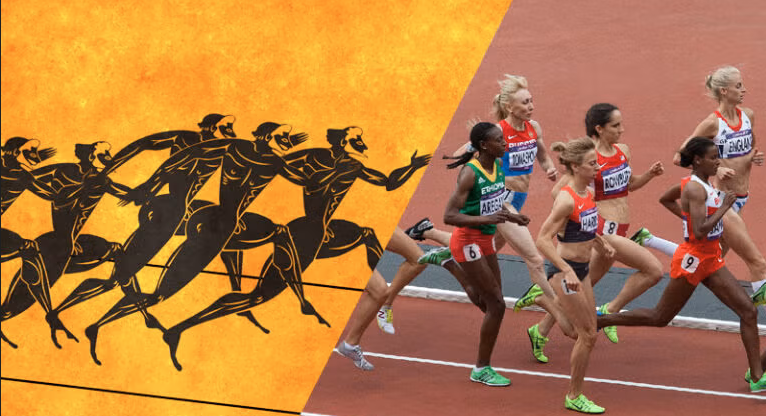
When we watch the Olympics today, it feels like the pinnacle of modern civilisation: billions of viewers, multinational sponsors, dazzling stadiums. Yet the Games’ origins lie not in the age of television but in the dust and sanctuaries of archaic Greece. The first recorded Olympics, held in 776 BCE, were neither secular nor democratic. They were sacred, exclusive, and deeply political. If the modern Games are often accused of being over-commercialised, the ancient Games were instead dominated by religion and hierarchy. Curiously, I would argue that they were at once far “purer” in intention and far more “corrupt” in practice than the Olympics we know today.
A SACRED STAGE, NOT A STADIUM
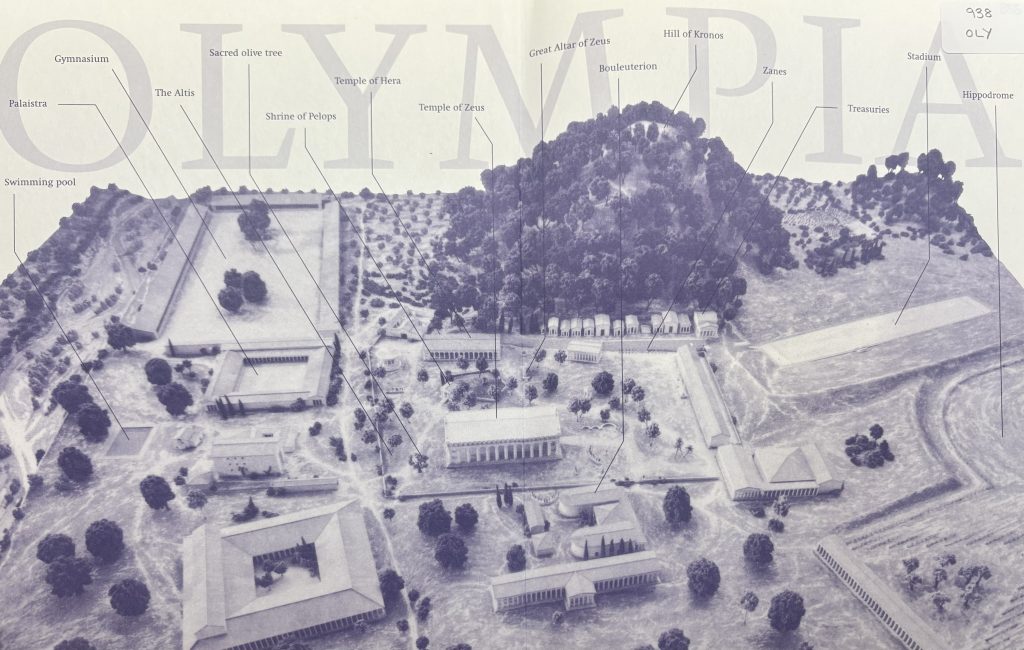
Unlike the rotating host cities of the modern Games, the ancient Olympics took place in one fixed location: Olympia. This was a sanctuary dedicated to Zeus, the king of the gods; the site contained temples, treasuries, and altars, most famously the colossal statue of Zeus sculpted by Phidias, later recognised as one of the Seven Wonders of the Ancient World.
This setting reminds us that the Games were first and foremost a religious festival. Competitors and spectators alike participated in sacrifices, most notably the slaughter of one hundred oxen at the great altar of Zeus. Athletes swore sacred oaths before his statue, promising not to cheat. The olive wreath, the only official prize, symbolised divine favour rather than material reward. In this sense, the Games appear “purer” than their modern successors: athletic excellence was framed as an offering to the gods, not a pathway to lucrative endorsement deals.
However, I would argue that this purity masks an uncomfortable truth. The Games were accessible only to a narrow elite: freeborn Greek men. Foreigners, enslaved people, and women were excluded. Women could not even spectate, except for the priestess of Demeter Chamyne. An exception existed in chariot racing, where women could own teams and be declared victors- Spartan princess Kyniska became the first female Olympic champion around 396 BCE- but this was a loophole of wealth, not inclusivity. Thus, while religion sanctified the Games, it also reinforced their exclusivity. If the modern Olympics struggle with representation, the ancient Olympics institutionalised exclusion as part of their very identity.
BRUTALITY VS BRILLIANCE
The official motto of the modern Olympics is citius, altius, fortius– faster, higher, stronger. Yet the Greeks had long practised this ideal, albeit with fewer restraints. The earliest recorded event was the stadion footrace, a 192-metre sprint. Over time, competitions expanded: wrestling, boxing, discus, javelin, the long jump, and most notoriously, the pankration. This “all-power” contest combined wrestling and boxing with minimal rules. Apart from prohibitions on eye-gouging and biting, almost anything was permitted. Ancient accounts describe competitors killed in the ring, with the victor still crowned.
To modern sensibilities, this brutality appears barbaric. But within Greek culture, it embodied the pursuit of arete: excellence or virtue. Victory meant eternal honour (kleos), with winners immortalised in poems by Pindar and Simonides, rewarded by their city-states with free meals for life, and sometimes honoured with statues. Compassion was absent; physical dominance was celebrated. Here, I would argue that the Greek Olympics expose the darker undercurrent of the sporting ideal: excellence without ethics. Modern audiences recoil from deaths on the field whereas ancient spectators saw them as proof of divine favour.
POLITICS IN THE GUISE OF SPORT
A persistent myth imagines the ancient Olympics as “apolitical” because of the ekecheiria, the sacred truce that paused warfare during the Games. Yet this supposed neutrality was itself a political act. The truce guaranteed safe passage for athletes and spectators, but it did not erase enmity between city-states. Victories became tools of propaganda. A triumph at Olympia signalled the superiority of one’s polis, much as Cold War medal tables later became measures of ideological dominance.
Consider Alcibiades, the controversial Athenian statesman, who entered seven chariots in the 416 BCE Games and took first, second, and fourth place. His victories were not just athletic; they were political theatre, designed to showcase Athenian wealth and ambition. The Olympics, far from neutral, were battlegrounds of prestige. This comparison complicates the modern narrative: while today’s Olympics are criticised for nationalism, the ancient Games were arguably even more entangled with civic rivalry and propaganda. Sport has always been political, even when dressed in the garb of sacred ritual.
PURITY AND EXCLUSION- THE QUESTION OF LEGACY
The ancient Olympics endured for over a millennium, finally abolished in 393 CE by the Christian emperor Theodosius I as part of his campaign against pagan worship. By then, the Games had become anachronistic in a Christian empire, their sacrifices and sanctuaries viewed as relics of idolatry. Olympia itself fell into ruin, buried by earthquakes and floods, until its rediscovery in the nineteenth century coincided with Pierre de Coubertin’s revival of the modern Games.
But what exactly was revived? The modern Olympics retain the spirit of peaceful competition, yet their values have shifted. Today, athletes compete for medals, sponsorships, and records. The Games generate billions in revenue, and host nations vie for soft power on a global stage. In contrast, the ancient Games offered no material prizes. The olive wreath was symbolic, and yet, paradoxically, winners could expect immense civic rewards at home- statues, pensions, political careers. Both versions of the Games, therefore, commodified athletes, whether for civic pride or for profit.
Here lies the paradox I keep returning to: the ancient Olympics were both more idealistic and more hypocritical than their modern successors. They were idealistic in their insistence that sport was sacred, an offering to Zeus, a reflection of divine order. Yet they were hypocritical in their exclusivity, their brutality, and their manipulation by political elites. The modern Games, by contrast, are commercialised and nationalistic, yet at least in theory they strive for inclusivity, allowing men and women of all nations to compete on equal terms.
MIRRORS OF CULTURAL WORSHIP
The Olympics, ancient and modern, are thus not simply athletic contests. They are mirrors reflecting the values of their respective societies. For the Greeks, they reflected piety, masculinity, and civic competition. For us, as mentioned above, it reflects nationalism, commercial power, and an ideal- however imperfect- of inclusivity.
To call the ancient Games “better” or “worse” misses the point. They were different answers to the same question: how can a society ritualise excellence? The Greeks answered through religion and exclusion; we answer through globalism and profit. Both are flawed, but both remind us that sport is never just sport. It is a language through which cultures articulate what they worship, whether Zeus or the market.
In this sense, I think we should resist romanticising the ancient Games as nobler or purer. They were both brutal and brilliant, sacred and corrupt, idealistic and political. If the modern Olympics are plagued by sponsorship scandals and national rivalries, they at least aspire to universality. The ancient Games did not.
The enduring lesson isn’t a paradox: the Olympics have always been more than games. They are spectacles of power, staged in the name of higher ideals and perhaps the most telling continuity is this: whether in 776 BCE or 2024 CE, we continue to gather around athletes, not merely to watch them run, but to watch them embody what we, as cultures, most desire to see.

Comment closely on the writing in the final Chapter (16) of Remainder considering ways in which it demonstrates the styles and concerns of the novel as a whole.
Year 13 English Literature OCR A-Level Coursework : 94% Final Grade In Chapter Sixteen of Tom McCarthy’s ‘Remainder’, the[…]

“Kinship Defines the Heroic”. Compare the ways in which heroism is influenced by Characters’ relationships in Beowulf and Antigone
Year 12 English Literature OCR A-Level Coursework : 94% Final Grade In both Beowulf and Antigone, heroism is inseparable[…]
David Danced Before the Lord with All His Might
“David danced before the Lord with all his might.” – 2 Samuel 6:14 I’ve always loved this verse, though[…]
No responses yet