
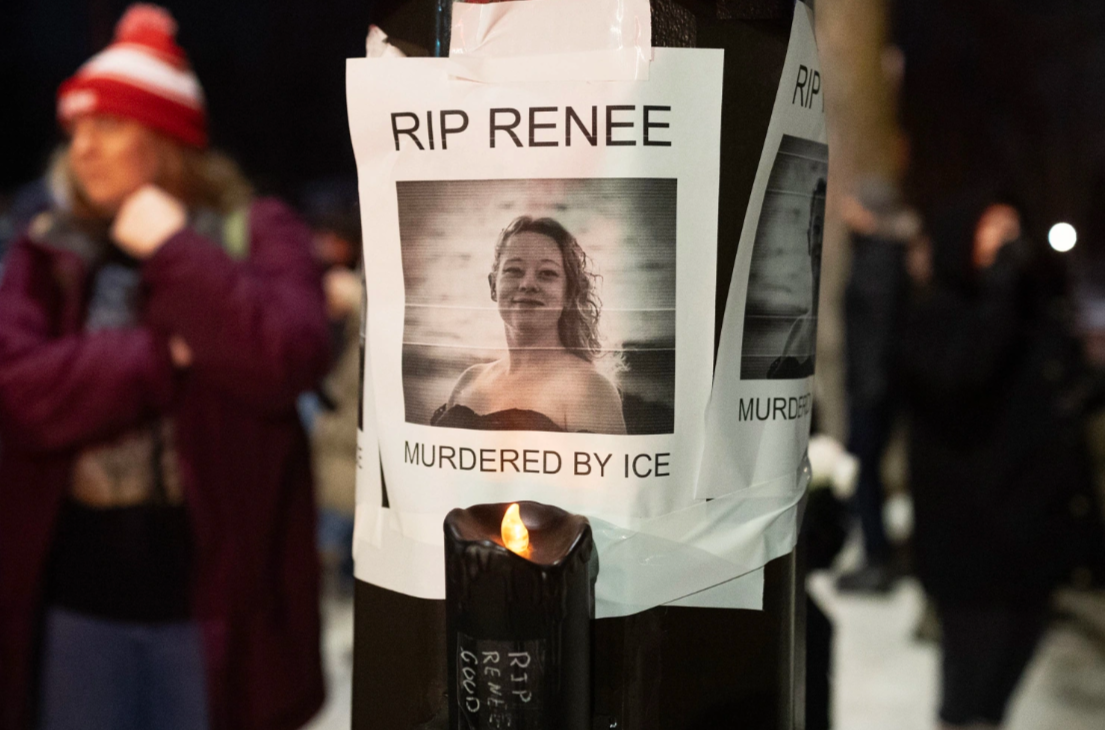
I didn’t think I would ever write about ICE.
Not because I don’t care – but because there are some systems so entrenched, so cruel in their mundanity, that engaging with them feels like screaming into a void. Immigration enforcement in the United States has long been one of those systems. It exists behind fences and acronyms and euphemisms. Detention, processing, removal. Words that sound procedural enough to hide the fact that what we are really talking about is people. Frightened, exhausted, often traumatised people- being swallowed by a machine that does not need to explain itself.
I keep seeing the footage of Renee Nicole Good being shot by that ICE officer , over and over, on my phone, my laptop, everywhere, and each time it makes my chest tighten in that quiet, hollow way grief sometimes does. I don’t watch because I want to; I watch because turning away feels like letting something slip by unnoticed, like being complicit. What gets me is how ordinary it all looks, like nothing about the moment should end in death, and yet it does. A second of choice, a few decisions, and suddenly it’s permanent. And then you see it, feel it, and are told you didn’t really see the full picture, that there’s a reason it happened- which is what Orwell meant when he wrote that the most effective way to destroy people is to “deny and obliterate their own understanding of their history.”
I wasn’t going to write about this. And then I did, because I couldn’t not.
I am not an American citizen. I say that deliberately, because it matters. I am watching this from the outside, from a position of relative safety and distance, and that distance is precisely why I feel a responsibility to speak. Silence is easy when the consequences are not yours. Silence is a luxury. And privilege, if it is worth anything at all, should be used to shine a light on what others are forced to endure in the dark.
On a January morning in Minneapolis, Renee Nicole Good was shot and killed by an ICE agent.
She was thirty-seven. She was a mother. A wife. A poet. She was a U.S. citizen. And she is now dead.
The official story tells us that the agent feared for his life. That Renee’s car was a weapon. That the shooting was unavoidable. These are familiar words, arranged in a familiar order, deployed with the efficiency of muscle memory. We have heard them before, after so many other deaths. But the problem is that there is video. Multiple angles. Clear footage. And what it appears to show is a woman trying to drive away.
Driving away.
Fear does strange things to people. Anyone who has ever been confronted by armed officers, shouting commands, guns visible, adrenaline high, understands that instinctively. You don’t think in clean legal categories when you’re scared. You think in impulses. You try to get out. And yet, for that instinct – for attempting to leave – Renee was shot. Not once, but multiple times. Shots fired into a vehicle. Shots that ended her life.
Regardless of the law, regardless of policy, regardless of whatever justification is being workshopped in press briefings, there is something grotesquely wrong here. You do not shoot someone in the face because they are afraid. You do not turn fear into a death sentence. You do not escalate confusion into fatal force and then ask the public to call it restraint.
And still, the defence came quickly. From politicians. From commentators. From people more invested in protecting the authority of the state than interrogating the cost of its actions. Watch the footage again, they say. And then, in the same breath, tell us not to believe it.
This is where ICE becomes impossible to separate from the killing itself.
Because Renee’s death did not occur in a vacuum. It happened within a system that has, for years, operated on the assumption that intimidation is effective, that fear is a tool, and that collateral damage is acceptable if it serves a broader agenda. ICE is not a traditional police force. Its agents are not required to undergo the same training as city or state police. Many are former law enforcement officers – often men who have left other departments – operating within a federal agency whose mandate has expanded rapidly, aggressively, and with minimal public oversight.
The result is an enforcement culture that blurs the line between civil immigration operations and militarised policing. Raids conducted in residential neighbourhoods. Officers in tactical gear knocking on doors before dawn. Armed confrontations over paperwork.
And when something goes wrong, when someone dies, the machine closes ranks.
It is impossible to talk about ICE without talking about its detention centres – places that exist largely out of public sight, but not out of reality. These are facilities where people are held indefinitely, sometimes thousands of miles from their families, often without meaningful access to legal representation. And one of the most quietly cruel aspects of this system is how utterly dependent detainees are on the outside world to secure their release.
In many cases, a person detained by ICE is given one chance to make contact. One phone call. If that call goes unanswered – if the number isn’t recognised, if the person on the other end doesn’t pick up – that opportunity is gone. Without an outside contact, they cannot obtain their ‘A-number’, the identification number required to deposit money, to hire legal counsel, to begin the process of fighting their detention. Without that number, there is no funding. Without funding, there is no lawyer. Without a lawyer, there is almost no chance of getting out.
It is a perfect bureaucratic trap. A chicken-and-egg situation designed not to help people navigate the system, but to grind them down inside it. You cannot get help without a number. You cannot get a number without help. And so people wait. In overcrowded rooms. Under constant surveillance. Separated from children. From partners. From any sense of certainty about what comes next.
The emotional toll of this is immense. Detention iss a psychological assault. Studies have repeatedly shown high rates of depression, anxiety, and PTSD among detainees, particularly asylum seekers and those with prior trauma. The conditions – lack of privacy, inadequate healthcare, poor sanitation, the ever-present threat of deportation – compound existing wounds.
And into this context steps ICE, guns drawn, authority unquestioned.
Renee Nicole Good was not detained. She was not being processed. She was not behind bars. And yet her death belongs to the same story. A story in which force is normalised, accountability is delayed, and the public is asked to accept violence as administrative necessity.
This is what disappointment feels like when it settles into your bones. A sense that the moral floor has dropped so low that we are now debating whether someone deserved to die for being afraid.
I keep thinking about that Orwell quote as a warning. Because the danger is not only that people are killed by the state. The danger is that we are trained to look away. To distrust our own perception. To accept that authority knows best, even when the evidence is right in front of us.
I am not American. But I am human. And from where I stand, this is not just a failure of policy or training or judgement. It is a failure of compassion.
Renee Nicole Good should still be alive.
And if we allow ourselves to be convinced otherwise- if we accept a world where fear justifies execution and video evidence is negotiable – then this will not be the last name we write, or forget, or scroll past.
It will simply be another life absorbed by a system that has forgotten how to see.

Comment closely on the writing in the final Chapter (16) of Remainder considering ways in which it demonstrates the styles and concerns of the novel as a whole.
Year 13 English Literature OCR A-Level Coursework : 94% Final Grade In Chapter Sixteen of Tom McCarthy’s ‘Remainder’, the[…]

“Kinship Defines the Heroic”. Compare the ways in which heroism is influenced by Characters’ relationships in Beowulf and Antigone
Year 12 English Literature OCR A-Level Coursework : 94% Final Grade In both Beowulf and Antigone, heroism is inseparable[…]

David Danced Before the Lord with All His Might
“David danced before the Lord with all his might.” – 2 Samuel 6:14 I’ve always loved this verse, though[…]
No responses yet