
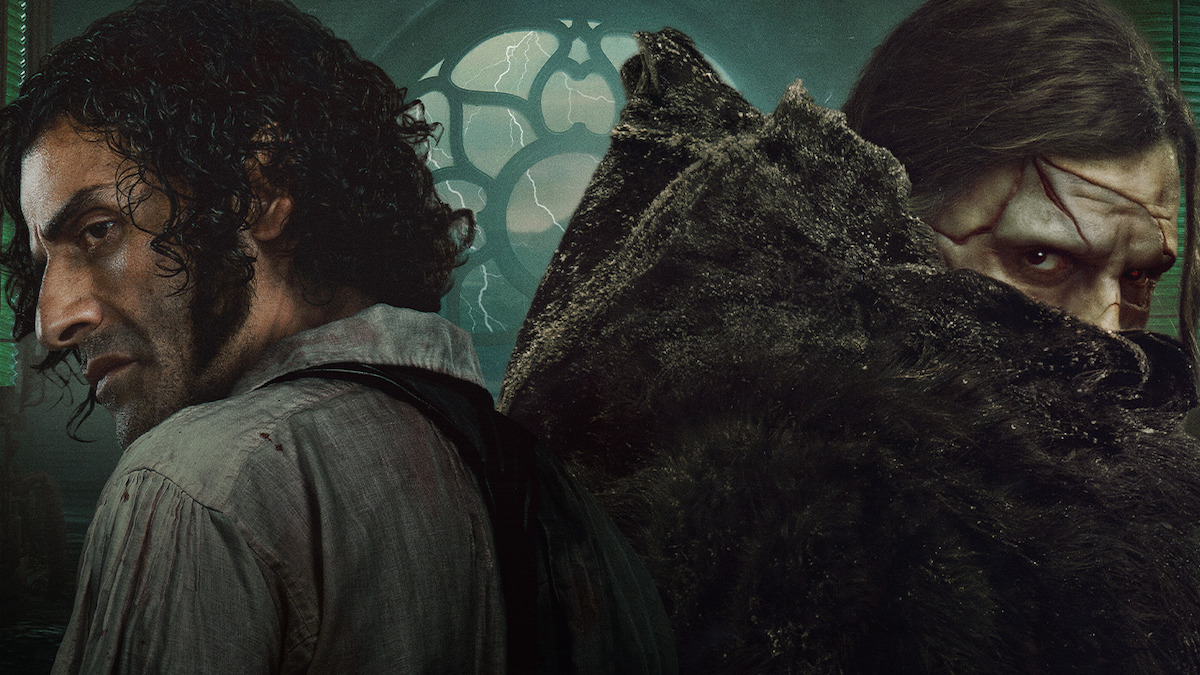
Although Frankenstein is frequently approached as a narrative about scientific transgression, the film, I would argue, resists the idea that life begins (or is determined) in a single moment. Instead, it presents existence as something repeatedly imposed, interrupted, and reconfigured by forces beyond the individual’s control: power, violence, recognition, and denial. The creature is shaped, fractured, and remade by the circumstances into which he is repeatedly thrown.
This essay therefore approaches the film through the framework of four distinct “births” in the creature’s life. These births do not refer to biological creation in any literal sense. Rather, they mark four pivotal moments at which the creature’s mode of being is fundamentally altered – moments when his relationship to himself, to others, and to the world is forcibly redefined. Each birth corresponds to a dominant symbolic element – God (creation), water, snow, and fire – and each signals a transition into a new ethical and emotional condition.
The logic of this structure arises from the film’s own visual and narrative grammar. At several key junctures, the creature undergoes an experience so total that it resembles a form of death followed by re-entry: the loss of one identity and the imposition of another. Across these moments, something is consistently taken from him – innocence, safety, passivity – and something else is acquired in its place: awareness, rage, resilience, endurance. Reading the film through these successive rebirths allows us to trace how monstrosity is a process instead of an origin point.
This framework also clarifies the film’s sustained interrogation of responsibility. Frankenstein names the creator, not the creation. The question the film repeatedly poses is not whether the creature becomes violent and indeed a creature, but whether Victor’s act of godlike creation, unaccompanied by responsibility, care, or love, constitutes a deeper and more enduring monstrosity.
The First Birth: Playing God and the Violence of Creation
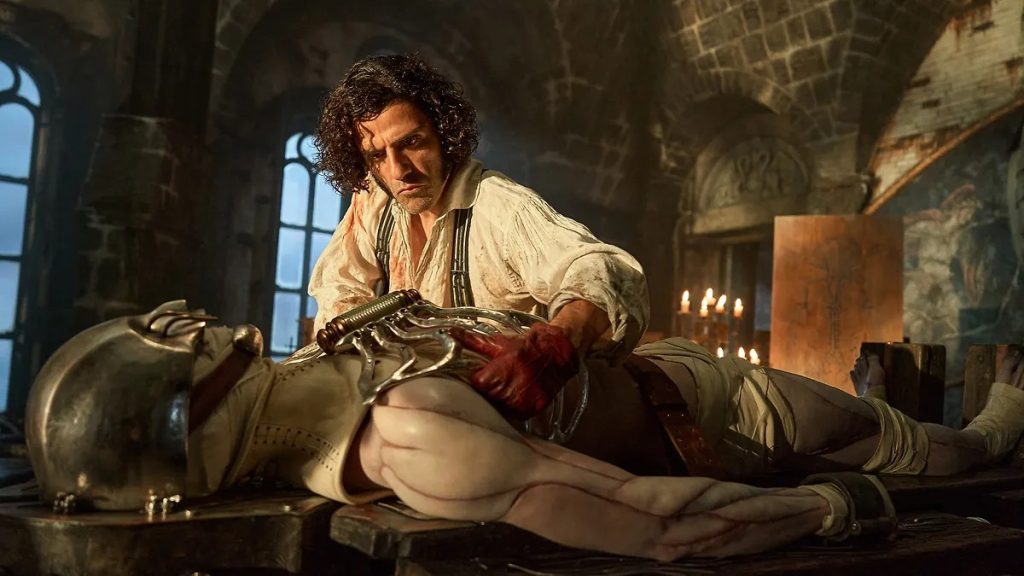
The creature’s first birth takes place in Victor Frankenstein’s laboratory, a space that is presented as both a site of scientific experimentation and of metaphysical ambition. While the story of Frankenstein is often reduced to, or overseen as just the idea of a man assembling a body and animating it, the film frames Victor’s project as something far more expansive: an attempt to conquer death itself. We see his existential pursuit, unable to be content with just understanding mortality and instead needing to override it.
This distinction matters because it repositions Victor’s act of creation in a theological scope. By generating life independently of any relational aspects, Victor assumes a godlike authority without accepting the obligations traditionally associated with it. Creation becomes an assertion of dominance and an absence of care in Victor’s hands.
The mise-en-scène of the laboratory reinforces this reading. The space is dim, enclosed, and ritualistic, illuminated by firelight and charged with surging electricity. The body is not treated as a neutral object of study but as the focal point of a deliberate, quasi-reverent procedure. When Victor later reflects, “in seeking life I created death,” he articulates the paradox embedded in his ambition: the desire to transcend mortality generates a form of destruction that he is ultimately unable to confront or contain.
Later, the old man observes that “man has questions for god,” an invocation that recalls Paradise Lost and its sustained concern with human curiosity, rebellion, and divine authority. He later adds, “even god has questions…. i think he wanted answers and that is why he sent us his son.” The contrast established here is so clear. In Christian theology, divine power is exercised through incarnation and relationship; God responds to humanity with presence. Victor, by contrast, responds to the problem of death by fabricating life and immediately recoiling from it. He creates a “son,” but refuses to enter into any reciprocal bond with him.
This refusal constitutes the creature’s first trauma. He understands Victor as a god who withholds grace. Deprived of affection, guidance, or recognition, the creature interprets his condition through a theological lens. “Because for every man there was but one remedy to all pain, death. a gift you had denied me,” he says, casting immortality as a punishment imposed by an indifferent deity. When Victor denies him love and companionship, the creature’s response follows a grim internal logic:
“If you are not to reward me love, then I am to indulge in rage.”
Violence, here, is thus not innate but reactive – the consequence of abandonment by a creator who refuses responsibility.
This pattern of withdrawal and displacement gestures toward a broader psychological inheritance within the Frankenstein lineage itself. Victor’s own father is emotionally distant, responding to suffering with authority rather than care. The film therefore suggests a cyclical logic: abandonment produces rage, and rage reproduces abandonment. A fuller exploration of this psychological inheritance, and its implications for Victor’s behaviour, will be taken up in Part II. (will be posted 25/12/2025)
A Diversion From the 1st Birth: Mirror Imagery, Self Recognition, Who is the Real Monster
The film’s recurring mirror imagery also destabilises the boundary between creator and creation. Drawing on the myth of Medusa – whose gaze petrifies and kills those who meet it directly – the film associates reflection with power, monstrosity, and survival. More specifically, the mirror which Victor and the creature sit in front of, recalls the myth of Perseus, who can defeat Medusa only by viewing her indirectly, through reflection, thereby avoiding death. Victor’s repeated positioning before mirrors aligns him with this logic. By refusing to look directly at the consequences of his creation – by engaging only through reflection, denial, and displacement – he imagines himself immune to the moral petrification that should follow such an act. The creature, too, is caught within this reflective logic: like Medusa, he is rendered monstrous, yet like Perseus, he cannot and does not “turn to stone”. His immortality becomes legible as a curse – a condition in which death, the ultimate release, is perpetually deferred – he looks in the mirror, like Perseus, and does not die.
Victor, meanwhile, consistently avoids sustained self-recognition. When he declares, “and you here are madness calling me back,” he does so while facing a mirror, ostensibly addressing the creature but implicitly displacing responsibility on himself. The creature frequently emerges from behind mirrors, visually staging the idea that Victor’s creation is not an external aberration, but an extension of himself. Even when Victor later condemns the creature as “wicked and defiled,” the force of the moment lies in its hypocrisy: he denounces in the creature what he cannot confront in his own actions.
The accusation is articulated explicitly elsewhere too: “only monsters play god”, says Elizabeth. The film does not deny the creature’s capacity for violence. What it insists upon is that the foundational rupture occurs at the moment of creation itself – when godlike power is exercised without care, continuity, or accountability. The first birth, then, establishes the conditions under which every subsequent transformation of the creature becomes possible.
Second Birth: Water, Movement, and the First Gift
The creature’s second birth unfolds as a passage rather than a conscious creation. Having fled confinement, he moves through a narrow, lightless tunnel before being expelled into open sea water. The visual grammar of the sequence unmistakably evokes parturition. The tunnel resembles a vaginal canal, not necessarily as anatomical literalism but as symbolic shorthand for birth emergence, while the sea functions as a kind of embryonic fluid: enveloping, sustaining, and prior to articulation. This is unlike the violent imposition of life enacted in Victor’s laboratory, it’s a transitional state in which the creature is momentarily held rather than commanded and curated. Water here receives him, bringing him into life itself.
This rebirth marks a decisive transformation in how the creature experiences existence. Unlike his first birth, which is imposed and immediately rejected, this one is lived through the body. Water becomes associated with movement, continuity, and the possibility of direction. The film makes this symbolism explicit through repeated visual attention to streams, reflections, and currents, as well as through the inscription “aqua est vita” (‘water is life’) carved into the stone tower. Life, the film suggests, is something that flows – not just begins.
The scene where the creature places a leaf onto the surface of the water and watches as it drifts away is so poignant to me. The leaf – fragile, unclaimed, and guided by forces beyond intention – becomes an emblem of organic life. He attempts to follow it, but is restrained by chains, forced to remain behind as it disappears into the open sea. This moment really articulates his tragic condition, highlighting that life is visible, even beautiful, yet structurally inaccessible to him. He can witness movement and life without participating in it.

This image acquires further resonance when the creature later offers Elizabeth a leaf. The gesture is modest, almost hesitant and childlike, but it functions as a gift of life – an offering of hope passed between two figures who are, in different ways, confined. Victor’s insistence that Elizabeth must be “kept in the dark for her own safety” mirrors this dynamic. In her case, the darkness refers to withheld knowledge about the creature; in his, it takes the form of restricted access to sunlight, water, and freedom itself. In both instances, Victor appoints himself arbiter of exposure, determining who may encounter life directly and who must be protected from it.
Moreover, the water tower, marked with the German inscription “Wasserwerk der Provinz” (‘waterworks of the province’) alongside the aforementioned Latin “aqua est vita,” situates Victor’s experiments within infrastructure intended for public sustenance. This is a building designed to distribute life evenly and invisibly, yet it is repurposed as the site of secretive, boundary-crossing creation. Water – a communal resource – becomes the backdrop for a profoundly private ambition. The film thus frames Victor’s transgression as social as well: his pursuit of mastery corrupts what should nourish the collective.
Third Birth: Snow, Violence, and the End of Innocence
The third birth is marked, ironically, by death. After living quietly alongside the men in the forest hut – repairing their gates, gathering firewood, and observing their routines from a position of cautious distance – the creature is discovered and hunted. He flees into the forest and collapses into freshly fallen snow, shot by men who cannot recognise him as anything other than a threat.
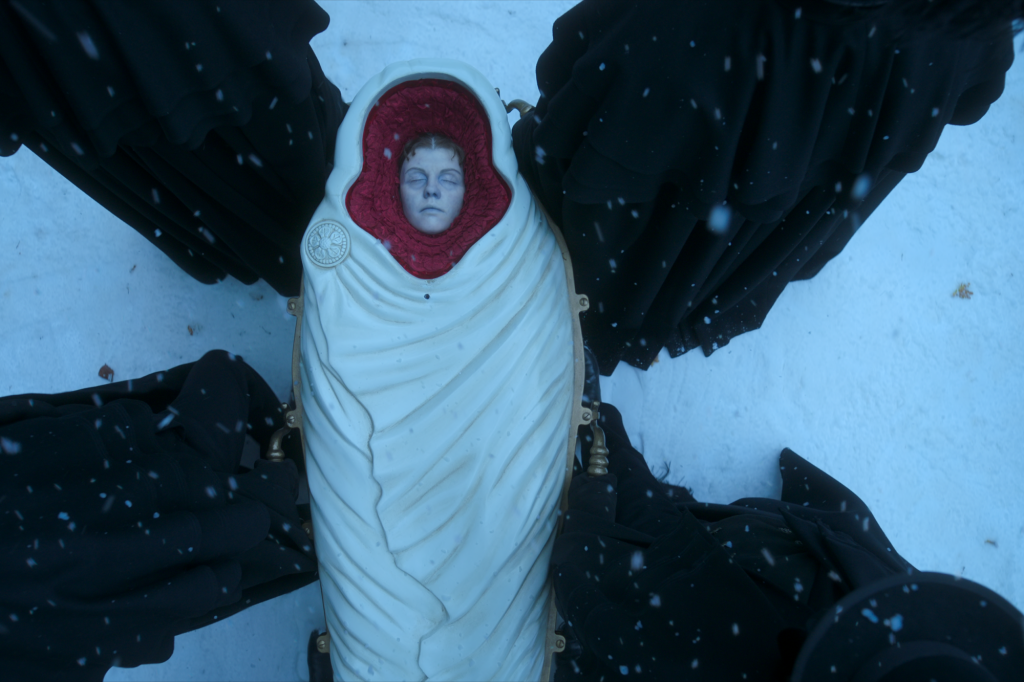
Earlier, the old blind man had described snow to the creature as a sign of purity. This is the creature’s first experience of it: a moment framed with childlike wonder, silence, and stillness. Snow, untouched and luminous, appears as the physical expression of innocence – a world briefly cleansed of judgement. That innocence is immediately violated when those men hunt him. Blood spreads across the white ground, staining it red. The image is stark and recurring throughout the movie: purity overwritten by fear, whiteness marked by violence. The film repeatedly returns to this notion -white made crimson – as shorthand for innocence destroyed by human aggression. Taking Elizabeth’s bridal dress, for instance, initially radiant and untouched, is later marked by blood; the old man’s white beard becomes framed by slaughter. The sole moment in which white is not corrupted occurs at the film’s conclusion, when Victor, dressed in white, remains unstained after the creature’s act of forgiveness – a gesture towards the creature’s transformation into a Christ-like figure and a reckoning that will be explored in Part II.
When the creature awakens, he is reborn into a colder world. Snow, as frozen water, adds to the film’s elemental logic. His second birth into water promised movement, connection, and the possibility of life shared with others. This third birth takes place in the same element, but altered: water arrested into ice. What was once fluid has hardened. Kindness has frozen over. The rebirth signals a tonal shift in the film from tentative hope to merciless clarity. This is the world as it truly is, governed not by care but by force.
A Diversion from the 3rd Birth: The Wider Picture, Animal Imagery, War
It is here that animal imagery becomes central to the creature’s moral education. Until this point, his experiences with animals have been marked by gentleness and mutual recognition. He feeds and approaches a deer in the forest, offering it food. Likewise, the rats in the hut have a mutual reciprocity with him. The animals do not recoil from him. They respond without fear. In this moment of quiet intimacy, the creature witnesses a form of innocence unmediated by judgement.
That innocence is shattered when two men emerge and shoot the deer. One of them gestures toward the creature and asks, “what is that?” The question is devastating in its simplicity. The creature is not recognised as a being, but as an unknown category – something outside their own perimeter. Violence follows immediately. The gunshot is not a response to harm, but to difference. This same logic will soon be turned against the creature himself.
Later, when wolves descend upon the hut and slaughter the sheep the creature has been protecting, he articulates the realisation that will define him:
“the hunter did not hate the wolf, the wolf did not hate the sheep but violence felt inevitable in between them… perhaps this was the way of the world it would hunt you and kill you just for being who you are.”
This is the film’s clearest articulation of war logic. Violence is not born of personal hatred, but of structural inevitability. The hunter kills not because he despises the wolf, but because the wolf occupies a role deemed incompatible with survival. Identity becomes justification. Guns are instruments of classification and tools used to erase what cannot be assimilated.
The creature understands, finally, that he has been placed into the same logic. He is hunted not for what he has done, but for what he is perceived to be. The snow birth, then, is the moment he learns the cost of existing visibly in a world governed by fear.
One of the only people who recognise his humanity is blind. “i know what you are. a good man and you are my friend.” The film reveals a moral stance sharply here: physical sight, like that of the men, produces misrecognition, while blindness permits ethical clarity. Those who see the creature cannot look past appearance; the one who cannot see him perceives his humanity without hesitation.
Snow, once a symbol of purity and wonder, becomes the terrain on which innocence is extinguished. The third birth does not create the creature’s capacity for violence – it reveals the world’s. What dies in the snow is not merely the creature’s innocence, but his belief that kindness alone can secure belonging.
Fourth Birth: Fire, Destruction, Survival, and Transformation
The creature’s final birth occurs through fire, completing a trajectory in which each rebirth becomes progressively more violent. Where water offered possibility and snow marked the freezing of that potential, fire represents total severing: combustion, explosion, and irreversibility. This birth is no longer about entering life, but about surviving attempted destruction.
A Diversion From the 4th Birth: Fire Symbolism in the Wider Plot
Throughout the film, Victor repeatedly turns to fire as a means of control. Flames destroy buildings, engulf his tower, and erase evidence of failure. Fire, traditionally associated with Promethean creation and enlightenment, is here distorted into a punitive force – a technology of fear rather than progress. Elizabeth’s uncle’s metaphorical warning to Victor, “do not burn your hand,” gestures toward this classical inheritance: fire grants power, but always at a cost and carrying risk. Victor wields his own godlike force in the act of creation, a power meant to shape life itself, and then attempts to annihilate taht very life through fire. In this sense, fire becomes the instrument through which his ambition meets its limits as it is incapable of eradicating what he has set in motion.
The creature’s relationship to fire and is fundamentally different. Where Victor’s force is destructive, the creature’s engagement with fire nurtures and sustains; in the early parts of the movie he gathers wood for the men in the forest hut, contributing to their survival from a distance. In this sense, he briefly occupies the role Victor desired for himself: benefactor, provider, almost godlike in generosity. Where Victor’s fire annihilates, the creature’s acts enables living.
This contrast reaches its most devastating articulation in the dynamite sequence. Believing fire will finally succeed where all else has failed, Victor hands the creature explosives, expecting annihilation. Instead, the creature holds the dynamite like a prayer candle. The image is arresting precisely because it is not triumphant, it reveals the suffering he has endured. The posture evokes ritual and supplication however the creature does not resist death so much as plead and pray for it. Fire is an agony he survives but does not want to.
When the explosion fails to kill him, the creature rises from ash once more. This rebirth is more violent than any before it. He does not emerge into water or snow, but debris, smoke, and ruin. The escalation is obvious, here, exposing how life once offered gently by the world is now only accessible through catastrophe. Each birth teaches him how much living will cost; he cannot die, yet cannot belong.
This final birth thus completes the elemental arc. Water birthed hope. Snow froze it. Fire annihilates what remains- leaving only transformation into rage and eventually forgiveness. Fire’s final meaning is therefore suspended, unresolved, awaiting the creature’s last and most radical act: mercy.
In Part II, we will explore the creature more as a Christ-like figure – a benefactor, a figure of care, and ultimately a source of radical forgiveness – alongside the final confrontation between creator and creation. We’ll also examine the women of the story, specifically Elizabeth, the symbolism woven into her costumes, and the psychological underpinnings of Victor Frankenstein himself: from his obsessive desire to control life to the legacy of neglect and fear that drives his actions. These parts converge to reveal a final insight: the real monstrosity lies not in the creature, but in the failure to temper creation with responsibility, and the film’s ultimate message hinges on the transformative power of recognition and mercy.
check out part 2 TOMORROW!!! 25/12/2025 and MERRY CHRISTMAS 🙂
Comment closely on the writing in the final Chapter (16) of Remainder considering ways in which it demonstrates the styles and concerns of the novel as a whole.
Year 13 English Literature OCR A-Level Coursework : 94% Final Grade In Chapter Sixteen of Tom McCarthy’s ‘Remainder’, the[…]

“Kinship Defines the Heroic”. Compare the ways in which heroism is influenced by Characters’ relationships in Beowulf and Antigone
Year 12 English Literature OCR A-Level Coursework : 94% Final Grade In both Beowulf and Antigone, heroism is inseparable[…]
David Danced Before the Lord with All His Might
“David danced before the Lord with all his might.” – 2 Samuel 6:14 I’ve always loved this verse, though[…]
No responses yet