
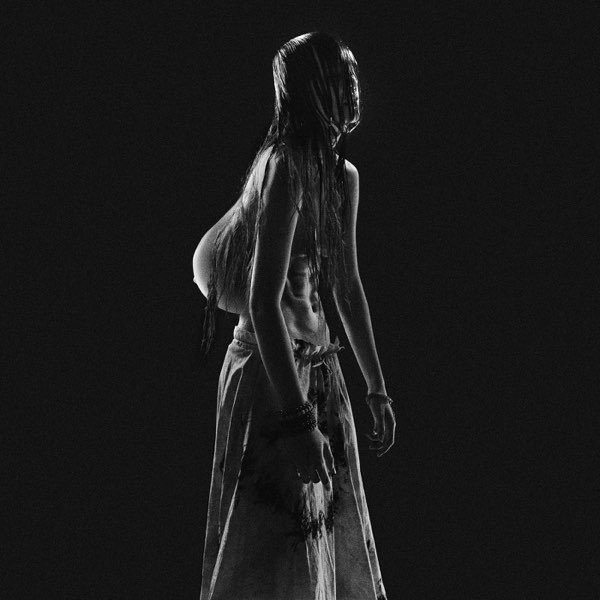
Pt.1 of the series: Song Interrogations
Sofia Isella’s The Doll People is a confrontational and poetic exploration of the objectification and commodification of women. Framed through violent imagery and sardonic humour, the song interrogates the ways in which femininity is packaged, consumed, and ultimately discarded by men. Its message is uncompromising, suggesting that women are both subject and object, pulse and porcelain and simultaneously complicit in and resistant to their objectification.
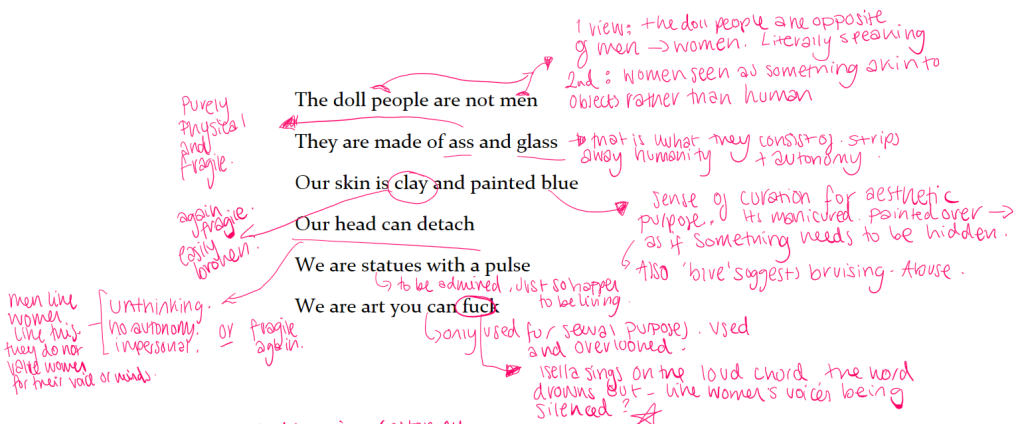
From its opening lines, the song rejects any notion of women as autonomous human beings. “The doll people are not men” operates both literally and metaphorically. Literally, the ‘doll people’ are women, but metaphorically, they are something other than mankind and human, something lesser. Dolls are not people, they are objects for play, decoration, and possession. Isella then collapses the boundary between art and flesh with violent concision: “They are made of ass and glass.” Here, the women are reduced to their sexual attributes (“ass”) and their fragility (“glass”), simultaneously hypersexualised and breakable. They are shaped, painted, moulded for aesthetic pleasure (“our skin is clay and painted blue”), the colour blue evoking both artistic curation and the bruises of abuse.
The motif of the detachable head- “our head can detach”- emphasises not only fragility but the denial of intellect and autonomy. These women are constructed to be admired, not to speak or think. Moreover, In one of the song’s most brutal refrains, Isella declares, “We are art you can fuck,” disintegrating the traditional reverence for art into an act of violent consumption. The explicitness of the lyric is further drowned out by its musical delivery as her singing is almost drowned out by the harsh, loud background chords- symbolising how women’s pain is often silenced and perhaps also aestheticised, robbed of its rawness in favour of palatable spectacle.
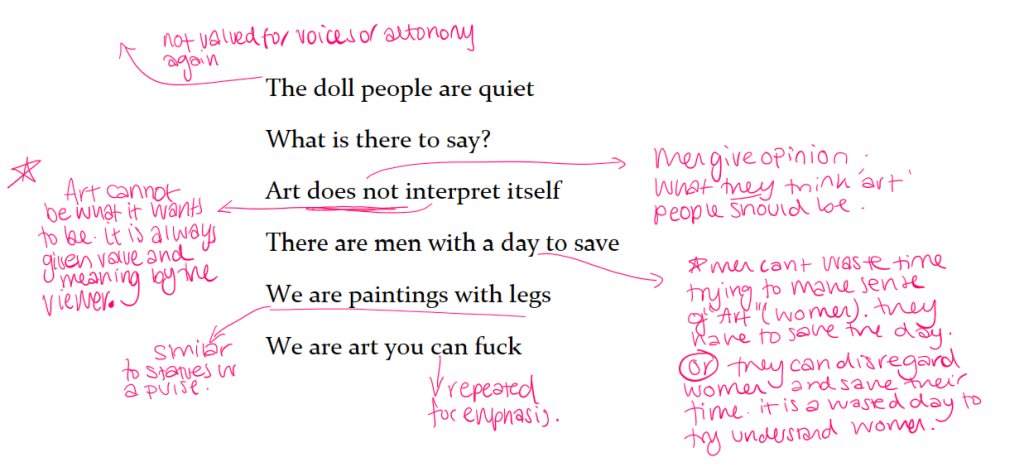
The song critiques not only how women are objectified but how their meaning is controlled. “Art does not interpret itself” strikes at the heart of the patriarchal gaze: women, like art, are spoken for rather than speaking. Their value is determined externally, they can never determine their own meaning or value as it is subjectively imposed upon by a viewer. This is emphasised further in the line “A woman who doesn’t want it is much hotter than one that does,” laying bare a pervasive cultural fascination with non-consensual female suffering as erotically charged. Here, Isella confronts rape culture without euphemism, exposing how desire and self determining in women is vilified, while resistance and passivity is fetishised.
Furthermore, male agency is presented as preoccupied elsewhere: “There are men with a day to save.” Heroic narratives, traditionally male-dominated, do not allow time for the messy complexity of understanding women. Women’s inner lives are seen as distractions from more ‘important’ male pursuits who must “save the day”.
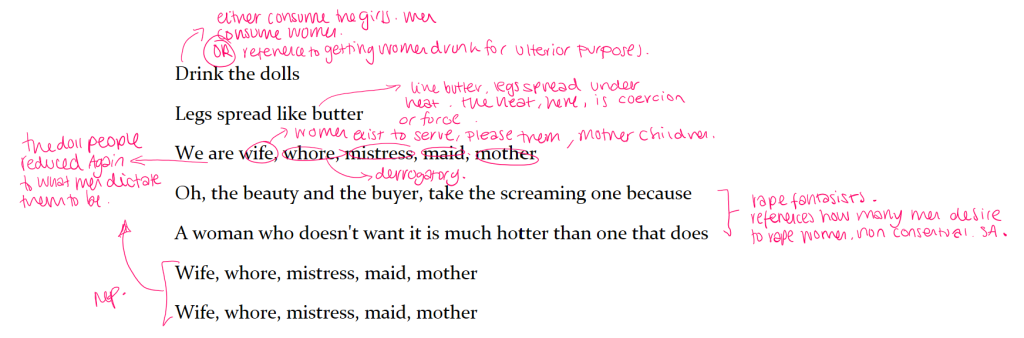
The refrain “Drink the dolls / Legs spread like butter” employs metaphors of consumption and melting, further stripping away agency. Women are to be ingested, melted, softened under male desire. The repeated list “wife, whore, mistress, maid, mother” catalogues the narrow archetypes available to women within patriarchal narratives, all of which define them in relation to men. None of these roles allow for independent personhood; they are functional categories within male desire.
Isella repeatedly pairs the “beauty and the buyer”, invoking the commodification of femininity-beauty becomes something purchased and owned. The song forces listeners to confront the transactional nature of this exchange, where women are the objects of trade and the currency is their subjugation.
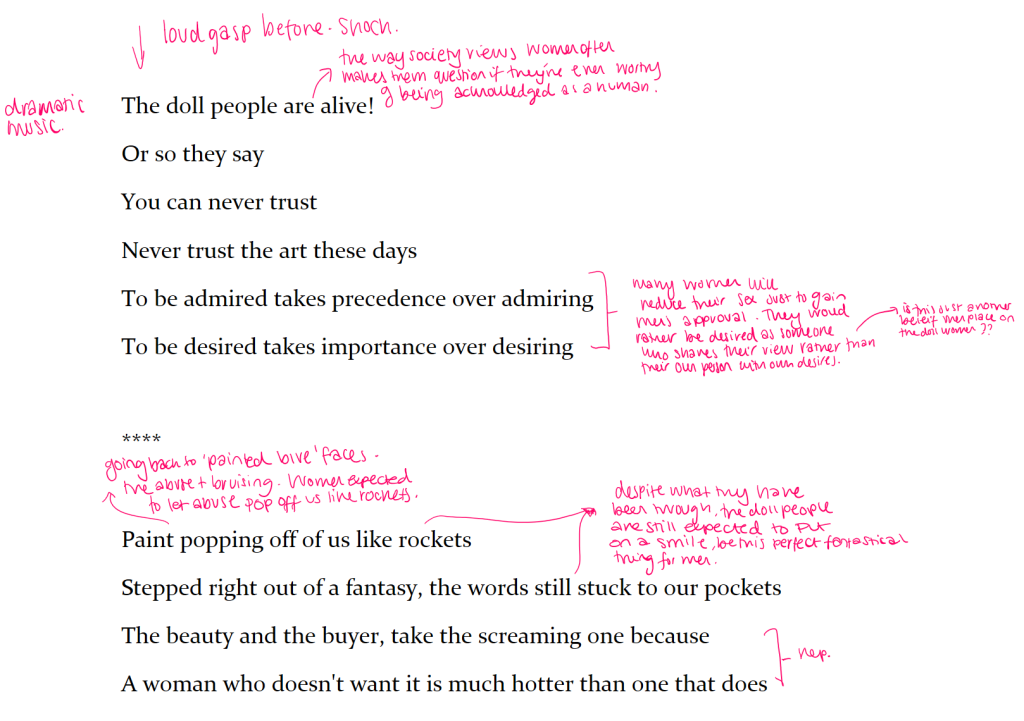
Midway through the song, there is a gasp, both literal and metaphorical, as the song explains, “The doll people are alive!”. This could be read as a moment of self-realisation, like a challenge to the lifeless identity imposed on them. But it is short-lived : “You can never trust the art these days.” Even in the doll’s declaration of life, they remain trapped in the frame of their objectification. The external gaze doubts their autonomy as untrustworthy.
Lines like “To be admired takes precedence over admiring / To be desired takes importance over desiring” dissect how women are conditioned to prioritise being the object of desire rather than expressing desire themselves, perhaps also referencing how women often reduce their sex to gain men’s approval.
The line “Paint popping off of us like rockets” is a moment of forced endurance. The paint as the carefully crafted outer layer of beauty and perfection mentioned earlier doesn’t wear away gently, it explodes off their bodies violently. Another stance on this section is that in this world, women are expected to shed the signs of their abuse quickly, dramatically, and move on as though nothing happened. Their pain is not a reason for care or concern; it is something to be brushed aside, an inconvenience in the fantasy of who they are supposed to be.
“Stepped right out of a fantasy, the words still stuck to our pockets” continues this idea. Even when women try to escape the roles imposed on them- try to leave the fantasy- the language that defines them clings to them. The labels of “wife, whore, mistress, maid, mother” don’t disappear; they are carried with them like objects in a pocket, always weighing them down.
In this part of the song, Isella exposes a culture where women’s pain is spectacularized but ultimately dismissed. They are expected to carry on, smiling and desirable, while their suffering is treated as irrelevant noise.
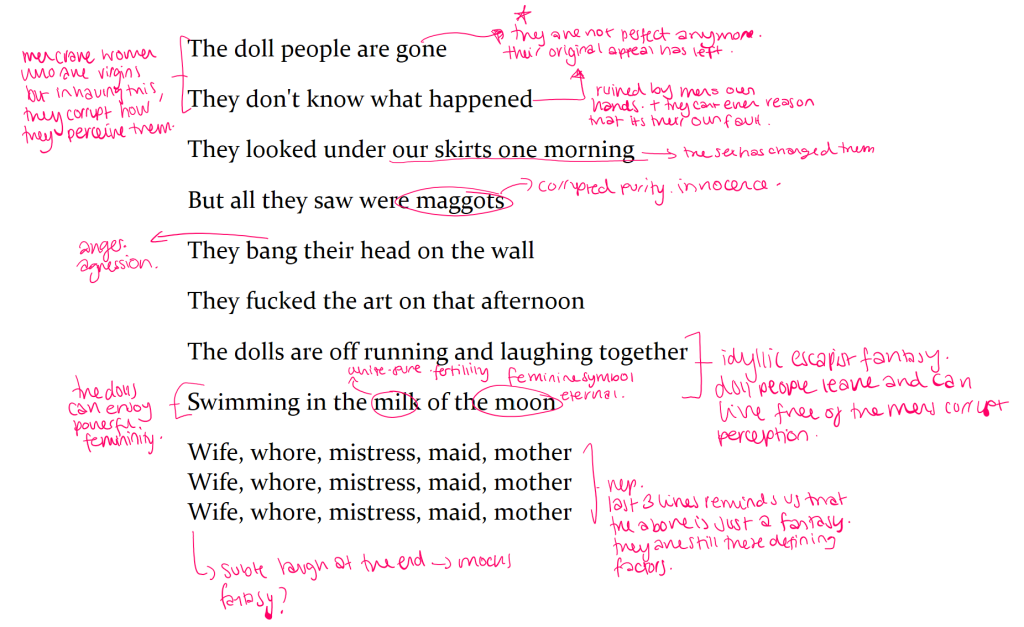
As the song reaches its final section, the doll people disappear- “The doll people are gone. They don’t know what happened”. The women, once seen as perfect, passive objects of desire, have slipped beyond the men’s grasp. But this disappearance is not celebrated by those who consumed them; it is met with confusion and anger. When the men “looked under [their] skirts one morning,” expecting to find the same purity, the same untouched beauty, they are confronted instead with “maggots.” The stark, grotesque imagery confronts the listener with the hypocrisy at the core of the virgin ideal: men worship innocence, yet in their consumption of it, they destroy it.
This moment reflects a brutal paradox. Men crave the fantasy of the untouched woman, innocent, compliant, pure, but in seeking to possess her, they corrupt her in their own eyes. They turn their desire into something violent and invasive, and when the woman no longer fits their fantasy, they recoil in disgust. The “maggots” are a reflection of what men have projected onto them. And yet, the blame is never turned inward. Instead, the men “bang their head on the wall,” directing their frustration outward, not towards their own destructiveness.
“They fucked the art on that afternoon” captures this self-destructive impulse. In consuming what they claim to love, they destroy it. The art—the women—is no longer something sacred or admired; it is violated and then discarded. But instead of recognising their role in this ruin, the men lash out at the object itself, unable to face the reality of their own actions.
Against this violent backdrop, the song offers a moment of escape: “The dolls are off running and laughing together, swimming in the milk of the moon.” Here, Isella imagines a feminine utopia, free from male distortion. The moon, often associated with female power, fertility, and cycles of renewal, represents a space where women can exist for themselves. The “milk” evokes both nourishment and purity, suggesting a return to an untouched, supportive femininity far removed from the corruption of male desire. But this freedom is fragile, perhaps even imagined. The final refrain, repeating “wife, whore, mistress, maid, mother,” pulls the listener back to reality. These roles still define the doll people. No matter how far they run, they remain trapped within these narrow identities. The subtle laugh at the song’s close feels mocking- whether directed at the futility of escape, the men’s delusions, or the entire violent system, it’s unclear. But it leaves the listener unsettled, aware that true liberation remains out of reach.
The Doll People thus is a brutal, unflinching commentary on how women’s identities are constructed and consumed. Isella refuses her audience the safety of euphemism or hope. Though moments of resistance appear, they are complicated as they are fleeting, and ultimately fragile, overshadowed by the cultural roles that refuse to let go. The final question lingers uncomfortably: can women ever escape the cages built for them, or- like art -will their meaning always belong to someone else’s gaze?
In this sense, The Doll People perfectly embodies César A. Cruz’s assertion that “Art should comfort the disturbed and disturb the comfortable.” Isella does not try to soothe listeners with poetic subtlety or sanitised rebellion. Instead, she wields blunt, crude imagery and harsh truths like weapons. There is no comfort- only the sharp discomfort of recognition. The song forces its audience, particularly those complicit in systems of objectification, to confront the raw, ugly reality of how women are consumed and discarded.
Comment closely on the writing in the final Chapter (16) of Remainder considering ways in which it demonstrates the styles and concerns of the novel as a whole.
Year 13 English Literature OCR A-Level Coursework : 94% Final Grade In Chapter Sixteen of Tom McCarthy’s ‘Remainder’, the[…]

“Kinship Defines the Heroic”. Compare the ways in which heroism is influenced by Characters’ relationships in Beowulf and Antigone
Year 12 English Literature OCR A-Level Coursework : 94% Final Grade In both Beowulf and Antigone, heroism is inseparable[…]
David Danced Before the Lord with All His Might
“David danced before the Lord with all his might.” – 2 Samuel 6:14 I’ve always loved this verse, though[…]
No responses yet